


Security Complexity and Energy Constraints Redefine Risk
Two forces reshaped cloud strategy in 2026, and neither is purely technical: security complexity and energy availability.
High‑profile breaches made one reality clear—cloud risk increasingly comes from structural complexity, not missing tools. Multi-cloud environments have grown faster than security teams’ ability to maintain visibility. Each added service, account, or credential expands the attack surface. More tools do not automatically mean more security; in many cases, they make environments harder to defend.
At the same time, AI workloads exposed a less visible constraint: power. Data centers now compete for electricity as aggressively as they compete for customers. In some regions, grid capacity—not compute—is the limiting factor for cloud growth. Energy reliability, cost, and sustainability have become strategic inputs to cloud decisions.
The leadership takeaway:
Cloud risk management now spans cybersecurity, operations, and infrastructure resilience. Executives must simplify security architectures, prioritize visibility over tool sprawl, and factor energy and sustainability into cloud planning. In the AI era, cloud strategy is no longer just an IT concern—it’s an enterprise risk and resilience decision.
Security Complexity and Energy Constraints Redefine Risk
At a Glance
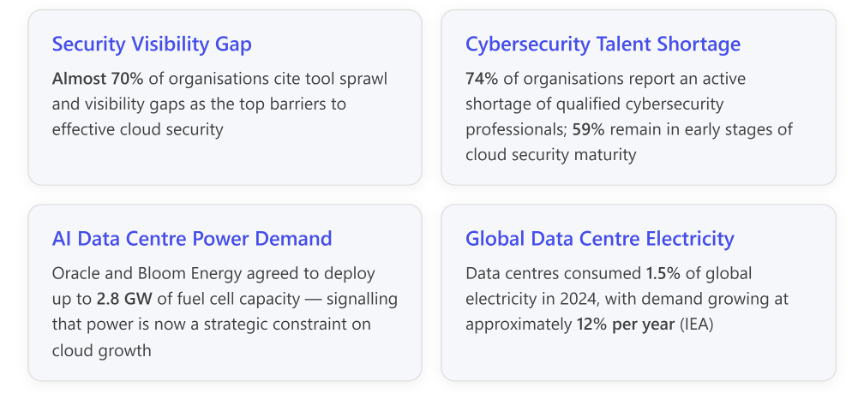
- Cloud security risk is structural. Almost 70% of organizations cite tool sprawl and visibility gaps as the top barrier — not lack of tools, but lack of integration across them.
- A high-profile breach proved the point. Shiny Hunters compromised an AWS API key via a supply-chain attack on the Trivy security scanner on March 19, 2026; the Commission’s Security Operations Centre did not detect unusual activity until March 24 — a five-day gap.
- 66% of cybersecurity professionals lack strong confidence in their ability to detect and respond to cloud threats in real time; 64% would consolidate to a single-vendor security platform if redesigning from scratch.
- Cloud growth now faces physical limits. In some regions, utility grids cannot meet demand from new data center projects without infrastructure upgrades that take years.
- Power availability is becoming a primary factor in site selection, alongside land and connectivity.
| Trend | Impact on Business | Leadership Action |
| Security Complexity Gap Almost 70% cite tool sprawl; 74% lack qualified staff | Visibility gaps lead to delayed breach detection (e.g., 5-day detection lag in the EC incident); 66% lack real-time response confidence | Consolidate security architectures into unified platforms; audit credential dependencies and tool-to-account access across the cloud estate |
| Cyber Talent Shortage 74% report staffing shortages; 59% at early maturity | Understaffed teams managing overcomplicated environments create systemic risk that tools alone cannot solve | Invest in cloud security talent and maturity assessments; evaluate whether adding tools helps or adds complexity |
| AI Power Demand 2.8 GW fuel cell deployment; data centers at 1.5% of global electricity, growing 12%/year | Capacity delays where power is scarce; rising energy costs directly impact cloud budgets | Factor energy reliability and sustainability into region and provider selection; assess provider power-sourcing strategies |
| Energy Diversification — Fuel cells (54–60% electrical efficiency), renewables, nuclear exploration | Cloud providers competing for power resources as aggressively as for customers; natural gas dependence remains for most fuel cell deployments | Include energy cost volatility (including potential carbon pricing) in multi-year cloud budget forecasts |