

Executive summary
Agentic commerce is crossing an important boundary. The conversation is no longer limited to whether artificial-intelligence agents can discover products or prepare transactions. The more consequential question is whether an agent can be trusted to initiate and complete a payment on behalf of a consumer or business.
October 2026 provided unusually strong evidence of this transition. AI payments dominated a full day of discussion at Money20/20 USA; a live Visa, BILL and Bill trust pilot began processing approved B2B invoice payments through AI agents; and policymakers elevated authentication, liability, fraud and interoperability as central payment-system questions. Source: FinTech Futures, Source: Visa, Source: Bank for International Settlements
The strategic implication is clear: the competitive advantage will not belong simply to the institution with the most capable AI. It will belong to the ecosystem that can prove—at machine speed—who delegated authority, what the agent was allowed to do, which controls applied, and why a payment was approved.
Why this topic deserves inclusion
The October signal was broad rather than dependent on a single product announcement:
- A central-banking speech published on 5 October identified agentic commerce as potentially transformative and set out unresolved questions concerning agent identity, authorization, liability and fraud. Source: Bank for International Settlements
- Money20/20 coverage on 21 October reported that AI-powered payments dominated industry discussions involving payments, technology, banking and commerce leaders. Source: FinTech Futures
- On the same date, a live commercial-payment pilot was announced in which agents could initiate and complete previously approved invoice payments. Source: Visa
- A post-event assessment published on 23 October concluded that AI agents, cybersecurity and stablecoins had taken center stage at the conference. Source: Mastercard
This is sufficient to establish strong industry attention without making an unsupported readership claim.
From assisted commerce to delegated authority
There are two materially different agentic-payment models.
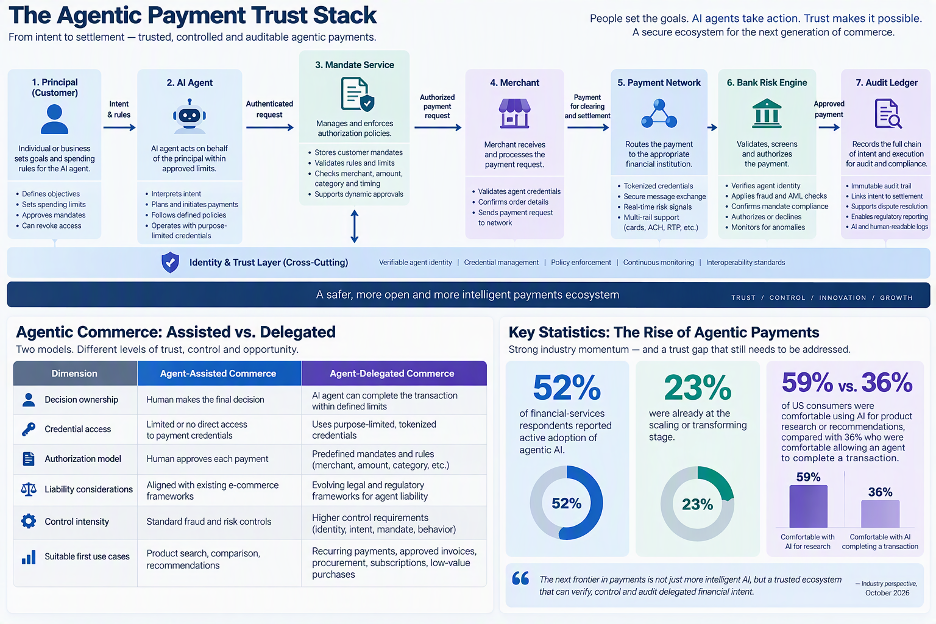
In agent-assisted commerce, AI helps a user search, compare or prepare a purchase, but the user remains responsible for the final decision and payment. In agent-delegated commerce, the user gives an agent authority to transact within defined limits. The second model is more powerful—and significantly more demanding from a control perspective. Source: Bank for International Settlements
Delegation changes the authentication question. Conventional e-commerce generally asks whether the person presenting a credential is authorized to use it. Agentic commerce must additionally establish:
- whether the agent is genuine;
- which person or organization it represents;
- whether that principal authorized this category of action;
- whether the amount, merchant, timing and purpose fit the mandate;
- whether the agent’s execution remained faithful to the original intent.
That is why the trust layer is becoming as important as the AI model itself.
The October commercial pilot provides a practical example. It uses tokenized payment credentials and connects buyer-side invoice approval with supplier-side acceptance. Its controls are designed to establish the agent’s identity, confirm its authority and preserve visibility into which transactions were approved. Source: Visa
Supporting facts and statistics
Industry adoption is advancing quickly, but strategic integration remains uneven:
- In a global study covering 628 institutions, vendors and authorities across 151 jurisdictions, 52% of financial services respondents reported active adoption of agentic AI; 23% were already at the scaling or transforming stage. Source: Cambridge Centre for Alternative Finance
- Eighty-one percent of financial services respondents surveyed expected agentic AI to be meaningfully realized by 2030. Source: Cambridge Centre for Alternative Finance
- Only 14% regarded AI as transformational to organizational strategy and competitive advantage, revealing a substantial gap between adoption and operating-model reinvention. Source: Cambridge Centre for Alternative Finance
- Research cited at Money20/20 found that 59% of US consumers were comfortable using AI for product research or recommendations, but only 36% were comfortable allowing an agent to complete a transaction. Nearly 75% still considered shopping with a preferred merchant important even when AI was acting on their behalf. Source: FinTech Futures
- Visa reported that its supplier analytics had identified more than $600 billion in potential credible spending since 2021. It also cited a projection that global B2B virtual-card volume could reach $14.6 trillion by 2029—an indication of the payment flows into which controlled automation could be introduced. Source: Visa
The message behind these figures is not that autonomous payments have already reached mass adoption. It is that the technical and commercial foundations are becoming substantial enough for trust architecture to become a board-level issue.
The technology drivers
1. Verifiable agent identity
Payment networks and platforms need a reliable method for distinguishing a legitimate, authorized agent from an impersonator or malicious bot. Registration, cryptographic identity and signed requests can provide evidence about the software initiating the interaction.
2. Machine-readable mandates
A delegated payment should carry more than a credential. It should carry a policy: permitted merchants, transaction ceilings, approved goods or services, time limits, geography, frequency and escalation conditions.
For corporate payments, mandates may need to reflect procurement policy, approved-supplier status, segregation of duties, invoice approval and budget availability.
3. Tokenized, purpose-limited credentials
Giving an AI agent unrestricted account access would recreate one of digital banking’s oldest weaknesses: overly broad credentials. Single-purpose tokens, virtual cards and transaction-specific credentials reduce the value of compromised access and make authorization boundaries easier to enforce.
4. Intent records and transaction provenance
When a transaction is disputed, institutions will need to reconstruct the chain of intent:
principal request → agent interpretation → merchant interaction → payment instruction → authorization decision → settlement.
Capturing that record can support dispute resolution, regulatory review and model-risk analysis.
5. Real-time contextual risk
Fraud systems trained on human browsing and purchasing behavior may misclassify legitimate machine activity or fail to detect malicious agents. Risk engines will need new features: agent reputation, mandate consistency, model provenance, transaction purpose, tool-use patterns and deviations from expected machine behavior. Source: Bank for International Settlements
6. Interoperable protocols
Platform-specific agent standards may accelerate early adoption, but fragmented identity, catalog, checkout and payment protocols would increase integration costs. Interoperability will be essential if smaller banks, Fintechs and merchants are to participate without joining a single closed ecosystem. Source: Bank for International Settlements
Industry impact
Agentic payments could reshape several layers of the financial-services market:
- Issuers may evolve from credential providers into real-time validators of delegated intent.
- Acquirers and payment processors will need to accept and preserve new agent and mandate data.
- Fraud platforms will have to differentiate trusted automation from malicious bot activity.
- Digital-wallet providers could become policy engines controlling where and how agents spend.
- Banks and treasury platforms may enable corporate agents to optimize payment timing, working capital and rail selection.
- Merchants will need machine-readable products, pricing, availability and return policies.
The commercial battleground may therefore shift from checkout speed alone to the quality of authorization, context and post-transaction evidence.
Banking and FinTech Relevance
For banks, the immediate opportunity is not to grant broad autonomy. It is to create bounded delegation.
High-potential early cases include approved invoice payment, recurring procurement, expense management, subscription administration, travel-policy execution and low-value data purchases. These activities have explicit rules, predictable counterparties and measurable outcomes.
FinTech providers can add value by supplying agent-identity services, policy engines, virtual credentials, transaction monitoring, audit records and multi-rail orchestration. The winners will integrate these elements into existing payment and treasury workflows rather than presenting agentic payments as an isolated AI product.
Enterprise implications
A credible enterprise program should include:
- a formal taxonomy separating advisory, preparatory and transactional agents;
- explicit financial limits and prohibited actions;
- role-based and purpose-based access;
- human approval for exceptions or policy changes;
- immutable logs of instructions, decisions and tool calls;
- real-time kill switches and credential revocation;
- incident procedures covering erroneous, manipulated or unauthorized transactions;
- contractual allocation of responsibility among model providers, agent platforms, banks, networks and merchants.
Governance should be designed before autonomy is scaled—not applied after an incident.
Opportunities
- Lower processing cost for recurring and rules-based payments.
- Faster conversion from approved obligation to completed transaction.
- More dynamic working-capital and payment-rail optimization.
- Better integration of procurement, invoicing and treasury.
- New revenue from agent identity, authorization and risk services.
- More programmable commercial-card and virtual-card propositions.
Risks and challenges
- Ambiguous liability when an agent misinterprets a request.
- Prompt injection or manipulation by malicious merchants and content.
- Credential theft, agent impersonation and mandate tampering.
- Excessive autonomy caused by poorly designed limits.
- Discrimination or unexplained decisions in risk scoring.
- Concentration around a small number of agent platforms and foundation models.
- Fragmented technical standards.
- Disputes where intent cannot be reconstructed.
Privacy and unreliable model output remain especially material: 74% and 70% of financial institutions surveyed, respectively, identified these as major AI risks. Source: Cambridge Centre for Alternative Finance
Future outlook
The likely path is staged rather than fully autonomous.
The first phase will emphasize read-only advice and transaction preparation. The second will allow agents to execute approved, low-risk actions within narrow mandates. Higher-value or unusual transactions will remain subject to human confirmation. Over time, the most trusted agents may receive broader authority—but only where institutions can continuously verify identity, intent and compliance.
Agentic payments will not be scaled because consumers and businesses suddenly decide to trust AI. They will scale when the payment ecosystem makes that trust technically enforceable, auditable and revocable.
Executive takeaways
- The central agentic-payment problem is no longer intelligence; it is verifiable authority.
- Identity, mandate and intent data must travel with payment instruction.
- B2B transactions offer attractive early use cases because procurement rules create natural guardrails.
- Existing fraud models will need to distinguish authorized machine behavior from hostile automation.
- Institutions should scale autonomy only after controls, auditability and liability arrangements are operational.