
Executive summary
October 2026 strengthened the case that stablecoins are moving beyond digital-asset trading and into regulated payments, treasury and banking infrastructure. But the evidence also rejects a simplistic narrative that blockchain automatically eliminates the cost and complexity of moving money across borders.
New October data showed rising use of stablecoin-linked commercial-payment programs. A major financial-technology provider placed a digital-asset platform into live operation with financial institutions. At the same time, new research found that stablecoins remain dependent on liquidity, fiat access, compliant intermediaries and reliable off-ramps. Source: Visa, Source: Fiserv, Source: BIS Working Paper
The strategic opportunity is therefore not “stablecoins versus banks.” It is the construction of a bank-grade orchestration layer able to choose intelligently among correspondent banking, FinTech money-transfer services, instant-payment systems, cards, tokenized deposits and stablecoins.
Why this topic deserves inclusion
October combined measurable adoption, production infrastructure and independent economic analysis:
- Visa published commercial-payment data on 1 October showing that stablecoins were gaining traction in settlement, treasury, payouts and cross-border commerce. Source: Visa
- On the same date, Fiserv announced that its digital-asset platform was live with financial-institution clients rather than remaining at proof-of-concept stage. Source: Fiserv
- On 19 October, a BIS working paper compared all-in cross-border costs across bank wires, FinTech money-transfer operators and stablecoin transfers. Source: BIS Working Paper
- Stablecoins, security and global payout networks were prominent across October’s Money20/20 agenda and post-event coverage. Source: Mastercard
The topic deserves inclusion because the industry discussion shifted from whether stablecoins have a payment use case to how institutions can operationalize that use case safely and competitively.
The current development: from crypto asset to operating rail
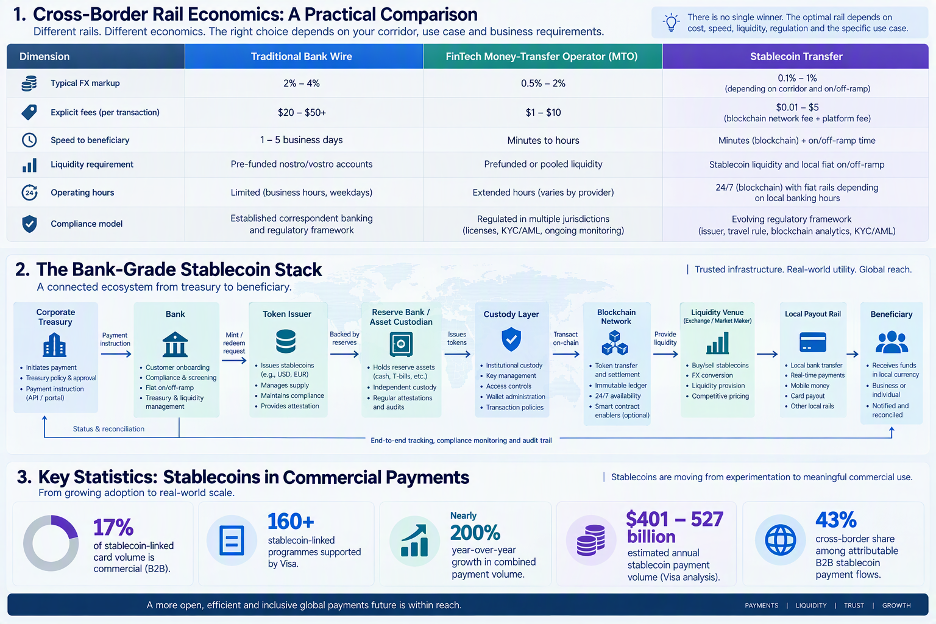
Visa reported that approximately 17% of stablecoin-linked card volume in its 2026 fiscal year to date came from business and commercial-card programs. It supported more than 160 stablecoin-linked programs, whose combined payment volume had grown nearly 200% year over year. Source: Visa
Research cited in the same release estimated annual stablecoin payment volume at between $401 billion and $527 billion. The largest reported categories included $56 billion in service fees, $43 billion in payroll and $28 billion in supplier payments. Of the attributable flows studied, B2B payments had the highest cross-border share, at 43%. Source: Visa
Production infrastructure is also emerging inside familiar banking channels. Fiserv’s first live platform use case involved a dollar-backed token for interbank movement among more than 90 participating banks and credit unions. The implementation combined issuance, reserve management, custody and settlement services, while participating institutions accessed the capability through an existing commercial online-banking environment. Source: Fiserv
This is strategically important. Adoption becomes easier when digital assets are embedded into the systems, entitlements and controls that institutions already use.
Stablecoins do not remove the payment stack
The strongest October evidence also introduces discipline into the discussion.
The BIS comparison found foreign-exchange markups of approximately 2% to 4.7% in its small sample of traditional bank wires, before explicit wire fees. For a $10,000 transfer from the United States, median FinTech money-transfer costs to developed-market currency groups were approximately $40 to $60. Source: BIS Working Paper
Stablecoin transfers can offer favorable pricing in corridors, but their all-in economics include more than blockchain fees. Users may face:
- fiat-to-stablecoin conversion;
- exchange trading charges;
- blockchain transaction fees;
- custody and wallet costs;
- stablecoin-to-fiat conversion;
- withdrawal charges;
- bank-processing delays;
- liquidity spreads, especially outside major US-dollar pairs.
The research concluded that stablecoins are not a universal remedy for cross-border friction. Their competitiveness depends on market liquidity, dependable fiat access, compliance and trust in intermediaries. Source: BIS Working Paper
This leads to a more mature proposition: the future is unlikely to be one dominant rail. It will be an orchestrated market in which technology selects the best combination for a particular corridor, amount, currency, counterparty and service-level requirement.
Technology Drivers
1. Tokenized settlement assets
Stablecoins and tokenized deposits can provide near-continuous transfer and programmable settlement. Their usefulness increases when they represent credible claims, have transparent reserves and can be redeemed reliably.
2. Wallet and custody infrastructure
Banks require institutional custody, key management, transaction-policy controls, recovery procedures and wallet-risk intelligence. Consumer-grade wallet designs are insufficient for regulated treasury operations.
3. Fiat on- and off-ramps
A technically instant blockchain transfer has limited value if the recipient cannot access local currency quickly or economically. Bank accounts, exchanges, market makers and local-payment connections remain essential.
4. Liquidity and FX engines
Cross-border competitiveness depends on executable liquidity, not a theoretical exchange rate. Institutions need real-time visibility into spreads, depth, fees and settlement certainty across both conventional and tokenized markets.
5. Compliance orchestration
Sanctions screening, transaction monitoring, originator and beneficiary information, wallet-risk analysis and travel-rule requirements must be coordinated across on-chain and off-chain systems.
6. API-led multi-rail routing
The strategic layer is a routing engine that evaluates cost, speed, availability, regulatory status, counterparty preference, liquidity and risk before selecting the payment path.
Industry impact
Stablecoins are changing the competitive basis of cross-border payments in four ways.
First, they challenge the assumption that value transfer must be restricted to banking hours. Second, they expose the cost of prefunding and trapped liquidity in correspondent arrangements. Third, they make programmable settlements commercially relevant. Fourth, they invite software platforms and treasury providers to participate directly in money movement.
However, regulated institutions retain crucial advantages: customer relationships, deposits, compliance capabilities, access to domestic payment systems and the ability to convert digital value into widely usable bank money.
The likely outcome is not disintermediation of banks, but reintermediation around new functions—custody, reserve services, compliance, liquidity, orchestration and tokenized account products.
Banking and FinTech Relevance
Banks need an explicit digital-money strategy covering:
- whether to issue, distribute, custody or settle stablecoins;
- how stablecoins relate to tokenized deposits;
- target corridors and customer segments;
- liquidity and redemption arrangements;
- integration with core banking, treasury and sanctions systems;
- wallet and counterparty risk;
- accounting and intraday-liquidity treatment;
- operational-resilience and recovery requirements.
FinTech providers have opportunities in API connectivity, wallet infrastructure, compliance analytics, cross-rail routing, FX optimization and reconciliation.
For both groups, the most compelling use cases are likely to be specific rather than universal: supplier payments, marketplace payouts, treasury sweeps, payroll for distributed workforces, settlement prefunding and corridors with poor conventional availability.
Enterprise implications
A stablecoin project should be evaluated as a financial-infrastructure program—not as a blockchain experiment.
The business case should calculate the full transaction chain, including conversion and liquidity costs. The architecture should preserve customer and transaction context across bank and blockchain systems. Treasury teams should model intraday liquidity and redemption stress. Compliance teams should define standards for wallets, issuers and counterparties. Operations teams should prepare for chain outages, frozen assets, delayed redemptions and reconciliation breaks.
Institutions should also decide whether a stablecoin transaction is final when it settles on-chain, when the recipient converts to bank money, or when the beneficiary can use the proceeds. Those are not always the same moment.
Opportunities
- Round-the-clock transfer and settlement.
- Reduced prefunding in selected corridors.
- Faster marketplace, supplier and contractor payouts.
- Programmable treasury and conditional settlement.
- New digital asset services for commercial customers.
- Greater competition and transparency in cross-border routes.
- Integration of cards, account and tokenized payment propositions.
Risks and challenges
- Reserve, issuer and redemption risk.
- Thin liquidity outside major currencies.
- Inconsistent regulatory treatment across jurisdictions.
- Sanctions, AML and wallet-screening complexity.
- Cybersecurity and private-key compromise.
- Smart-contract and blockchain-infrastructure failures.
- Accounting and reconciliation fragmentation.
- Dependence on exchanges, custodians and market makers.
- Misleading cost comparisons that exclude fiat conversion and withdrawal.
Risk intelligence will become especially important as institutions combine conventional and blockchain data. Money20/20 coverage highlighted new services intended to blend fiat and on-chain signals into a unified transaction-risk assessment. Source: Mastercard
Looking Ahead
The next phase will be defined by coexistence.
Banks will not abandon conventional cross-border rails. Instead, stablecoins and tokenized deposits will be added to a wider portfolio. Intelligent routing will choose among them according to the transaction’s economics and constraints.
Successful institutions will therefore focus less on promoting a particular rail and more on controlling the full journey: funding, conversion, transfer, compliance, settlement, redemption and reconciliation.
The strategic question is no longer, “Should we use stablecoins?” It is, “Under which conditions does a tokenized rail deliver a better customer and economic outcome—and can we govern the entire transaction chain?”
Executive takeaways
- Stablecoins are becoming payment and treasury infrastructure, but adoption remains corridor- and use-case-specific.
- The blockchain transfer is only one component of the all-in cross-border cost.
- Banks’ strongest opportunity lies in custody, liquidity, compliance and multi-rail orchestration.
- Production deployment through familiar banking channels will matter more than isolated pilots.
- The strategic winner will be the institution that selects the right rail—not the one that promotes a single rail for every transaction.