
Executive summary
For years, core modernization was framed as a high-risk technology replacement: select a new platform, migrate the bank and survive the conversion weekend. October 2026 evidence points to a different model.
Banks are increasingly separating modernization into business capabilities, moving them in sequence and allowing old and new platforms to coexist. One institution has already launched a new mobile platform and plans staged commercial-lending and deposit deployments. Another is migrating sequentially from a legacy core to a headless environment. Separately, seven institutions moved nearly one million users to a cloud-native digital platform through 19 modules, three core environments and two active mergers. Source: Yahoo Finance
Progressive modernization is not merely a safer IT method. It is becoming a market strategy—one that enables banks to release products, integrate FinTech services and respond to customer needs without waiting for a once-in-a-generation core replacement.
Why this topic deserves inclusion
October’s attention was driven by execution evidence rather than another modernization forecast:
- On 6 October, the American Bankers Association published real-world examples of banks replacing big-bang transformation with multiyear, sequential migration.
- On 15 October, Lumin Digital reported seven launches completed in just over four months, spanning consumer and business banking, account opening, payments, fraud protection and analytics.
- The launches covered 19 modules across three incumbent core platforms, while two institutions were simultaneously managing mergers.
Why big-bang transformation is losing appeal
A full core replacement concentrates many risks into one program:
- data conversion;
- product migration;
- customer and account reconciliation;
- channel integration;
- regulatory reporting;
- staff readiness;
- cutover;
- rollback;
- vendor coordination.
The attraction is architectural simplicity after completion. The danger is that an error in one area can compromise the entire conversion.
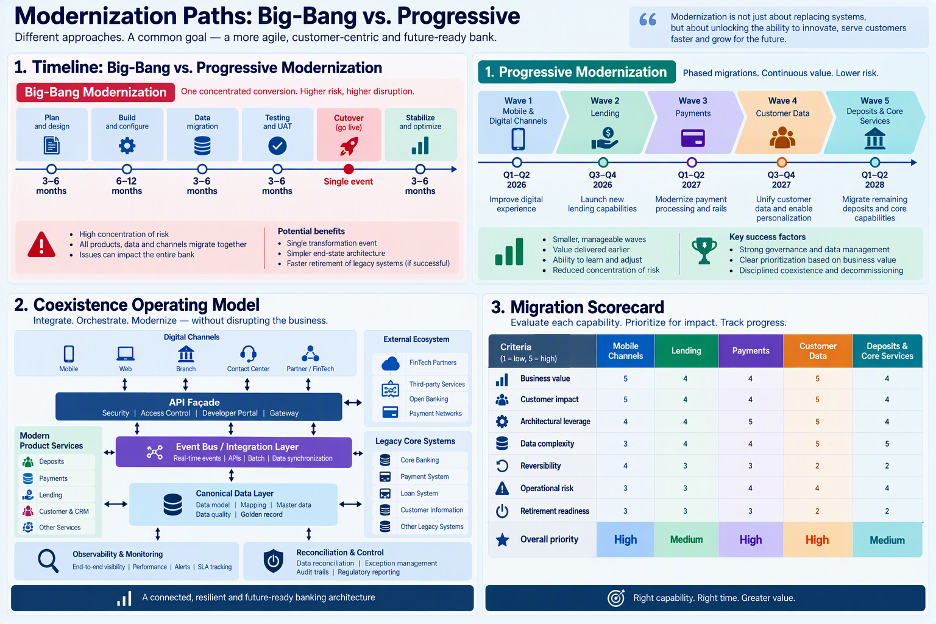
Progressive modernization distributes that risk. A bank may modernize mobile experience, lending, payments, customer data or deposits separately. Capabilities are moved according to business value, technical readiness and risk. Legacy services are retired progressively rather than on one predetermined weekend.
The October case evidence illustrates the approach. Regions Financial had already launched a new mobile platform, expected to deploy commercial lending later in 2026 and planned core-deposit deployment for 2027. Mascoma Bank was nearing completion of a sequential move from a legacy core into a headless environment, beginning with ancillary services and moving progressively toward the core.
Progressive does not mean simple
The trade-off is concentration risk versus coexistence complexity.
Big-bang migration creates a major cutover event. Progressive migration creates a longer period during which old and new systems must operate together. Customer, balance, transaction and product data may need to be synchronized across several platforms. Temporary integration can become permanent. Teams may experience continual change rather than one major transition.
As one October industry account summarized, progressive migration reduces transformation risk but increases the complexity of coexistence.
The operating model must therefore be designed around continuous modernization, not treated as a sequence of unrelated projects.
The technology drivers
1. Headless and modular platforms
Separating product processing from customer channels allows a bank to modernize the experience layer without immediately replacing the entire system of record. New services can be introduced behind APIs while legacy components continue to process selected products.
2. API façades and anti-corruption layers
A controlled integration layer can shield new services from legacy data structures. It translates formats, applies business rules and prevents each digital channel from developing a direct dependency on the old core.
3. Event-driven integration
Events—such as payment posted, limit changed or customer updated—can synchronize services more effectively than repeated batch extraction. Event architecture also improves the timeliness of fraud, notification and analytics capabilities.
4. Cloud and software-as-a-service delivery
SaaS shifts a greater share of platform operation and upgrades to the provider. This can allow bank teams to concentrate on product configuration and customer outcomes, although vendor-management and concentration risks must still be governed.
5. Automated testing and reconciliation
Every migration wave requires regression testing, parallel processing, balance reconciliation and exception handling. Automation reduces the operational burden and provides evidence that migrated and legacy outcomes remain aligned.
6. Observability across old and new estates
Banks need end-to-end visibility into service performance, data movement and transaction outcomes. Without shared observability, a customer problem may be passed between channel, middleware and core teams without clear ownership.
Supporting facts and market evidence
On the seventh of October digital platform launches provide useful evidence of the scale that modular transformation can now accommodate:
- nearly one million users moved to the new platform;
- seven institutions went live in just over four months;
- the program covered 19 platform modules;
- integrations spanned three core environments;
- two institutions migrated while managing active mergers;
- customers continued to be served during conversion and data migration. Source: Yahoo Finance
The modules extended beyond a front-end refresh. They included consumer and business banking, account opening, payments, fraud protection and analytics. Source: Yahoo Finance
These figures should not be treated as universal benchmarks: they come from a vendor announcement and each institution’s scope will differ. They are nevertheless credible evidence that multi-module, multi-core migration can be executed as a repeatable program rather than a single bespoke event.
Industry impact
Progressive modernization changes how banks buy, build and govern technology.
Procurement becomes capability based. Funding shifts from a single transformation budget to a portfolio of modernization waves. Vendor selection must consider interoperability and exit options, not just feature depth. Architecture teams become responsible for managing a changing estate rather than defining one final-state diagram.
The approach also changes competition. A bank that can configure and release products through modular services may respond more quickly to customer demand, partnerships or regulatory changes. Institutions locked into long release cycles remain dependent on large upgrade events.
Modernization velocity therefore becomes a commercial capability.
Banking and FinTech Relevance
Banks should prioritize modernization waves using four tests:
- Customer value: Does the capability materially improve speed, convenience or product choice?
- Economic value: Does it reduce operational costs, enable revenue or remove an expensive dependency?
- Architectural leverage: Will it make subsequent migrations easier?
- Migration risk: Can it be isolated, reconciled and reversed if necessary?
FinTech providers must support this model with clean APIs, modular deployment, portable data and transparent dependencies. A “composable” product that cannot coexist with the institution’s current environment is not operationally composable.
Core and digital-platform vendors will also need to support incremental adoption commercially. Contract structures based only on large, multi-year replacement programs may become less attractive than capability-based pricing and phased commitments.
Enterprise implications
Progressive modernization requires permanent transformation capability.
Portfolio governance
Each migration wave needs an accountable business owner, measurable outcome, retirement target and dependency map. Programs should not be approved solely because components are old.
Dual-run discipline
For a defined period, transactions or balances may be processed and compared across systems. The institution needs clear tolerance, reconciliation ownership and criteria for ending dual operation.
Data ownership
A canonical record must be defined for every material data element. Without clear ownership, synchronization can produce contradictory customers, product or balance information.
Change capacity
Continuous transformation places pressure on operations, risk, compliance, finance, customer service and technology teams. Temporary “bubble staffing,” specialist migration teams or dedicated platform squads may be required.
Decommissioning controls
Every modernization wave should include a funded retirement plan. Otherwise, the program adds a new platform while preserving the cost and risk of the old one.
Resilience and rollback
Incremental deployment does not remove the need for rollback. It makes rollback more targeted—but only if services, data and integration boundaries have been designed accordingly.
Opportunities
- Faster launch of products and digital experiences.
- Lower concentration of cutover risk.
- Better selection of specialist FinTech capabilities.
- Continuous platform and security upgrades.
- Easier adaptation during mergers and acquisitions.
- Reduced effort spent operating undifferentiated infrastructure.
- Greater ability to configure products rather than customize code.
Risks and challenges
- Prolonged legacy–modern coexistence.
- Duplicated data and inconsistent business rules.
- Temporary middleware becoming permanent technical debt.
- Increased third-party and vendor-management complexity.
- Staff fatigue from continuous change.
- Incomplete decommissioning and rising total cost.
- Fragmented accountability across multiple platforms.
- Cybersecurity gaps at integration boundaries.
- A collection of local migrations that never converges on a coherent architecture.
Progressive modernization should therefore be judged not only by what goes live, but by what is safely retired.
Future outlook
The emerging model is modernization as a continuous product, not a temporary program.
Banks will maintain prioritized capability roadmaps, reusable migration tooling, automated reconciliation and standing cross-functional teams. Core platforms will increasingly coexist with specialist lending, payments, data, identity and customer-experience services. The strategic architecture will be defined less by a single platform and more by governed boundaries between platforms.
This will not eliminate major transformations. Some products and data structures remain too tightly coupled for easy separation. But it will reduce the number of occasions on which an institution must place its entire operating model at risk in one cutover. The winning bank will not necessarily have the newest core. It will have the strongest ability to change its core environment repeatedly, safely and in step with market demand.
Executive takeaways
- Progressive modernization exchanges a single high-risk cutover for a longer period of controlled coexistence.
- Migration sequencing should be determined by customer value, economics, architectural leverage and reversibility.
- APIs and modular platforms are necessary, but data ownership, reconciliation and observability determine whether coexistence works.
- Every modernization wave needs a funded decommissioning outcome.
- The durable competitive capability is not owning a modern platform; it is being able to modernize continuously.