

Executive Summary
October 2026 produced an unusually coherent message for financial institutions: AI governance must move from principles and committees into live operational controls.
The Financial Stability Board published 12 sound practices covering governance, risk assessment, data, explainability, monitoring, human oversight, cyber risk and third-party dependencies. Four days later, the UK Financial Conduct Authority released practical examples of good and poor AI deployment. On 26 October, the Bank of England and FCA supplied the market evidence: AI use has become widespread, agents are already in production, third-party systems are increasingly material and post-deployment monitoring remains less mature than pre-deployment approval. Source: Financial Stability Board, Source: Financial Conduct Authority, Source: Bank of England and Financial Conduct Authority
The implication is not that financial institutions need another standalone AI policy. They need a control system that can prove what an AI system is for, who is accountable, how its behavior is monitored, what happens when it fails and how the institution remains operational if a critical provider becomes unavailable.
KEY STATISTIC
Third-party implementations represented 39% of reported AI systems but 53% of high-materiality systems. For third-party systems, 81% of respondents relied on vendor assurance and contractual arrangements, while only 24% reported deep knowledge of those systems. Source: Bank of England and Financial Conduct Authority
Three October Signals, One Direction
1. Global principles are converging
The FSB’s 12 practices span the complete AI lifecycle. They place responsibility with boards and senior management, require AI risk to be integrated into existing risk frameworks and call for continuous assessment after deployment, not simply approval at inception. Source: Financial Stability Board
2. Supervisory expectations are becoming operational
The FCA’s examples address how firms define consumer needs, test outcomes, assign accountability, maintain human escalation, map supplier dependencies and preserve fallback options. The publication creates no new rules or universal governance model, but it makes existing expectations more concrete. Source: Financial Conduct Authority
3. Adoption has moved ahead of control maturity
The joint survey found that 86% of respondents used AI, up from 75% in 2024. Generative AI represented 56% of reported AI systems, and 80% of full-survey respondents had AI agents deployed. Source: Bank of England and Financial Conduct Authority
The governance challenge is therefore immediate. Institutions are not preparing for an eventual AI transition; they are managing an existing production estate.
Key-Statistics Panel
| October 2026 finding | What it signals |
| 86% of respondents used AI | AI is mainstream in financial services |
| 80% of full-survey respondents had agents deployed | Agent governance cannot remain experimental |
| 94% reported firmwide AI policies, principles or standards | Formal policy coverage is relatively strong |
| More than 90% reported human approval, pre-deployment review and vendor due diligence | Front-end approval controls are common |
| Around half reported ongoing monitoring, leakage testing and periodic review or recertification | Runtime assurance is the maturity gap |
| 53% of high-materiality AI systems were third-party implementations | Material risk increasingly sits outside the institution |
| 88% expected frontier-AI cyber capabilities to have a moderate or high impact on risk profiles within two years | Cyber exposure is expected to intensify |
| 64% identified vulnerability management and patching as the area receiving the greatest increase in management attention | AI risk is influencing core cyber operations |
Financial services AI adoption and control indicators. Survey figures should be interpreted as evidence from participating firms, not as a census of the entire market. Source: Bank of England and Financial Conduct Authority
The Policy-to-Production Gap
Many institutions have AI principles, committees and approval processes. Those mechanisms remain important, but they are insufficient for systems that change behavior, depend on third-party models or operate continuously.
October’s data exposes a clear imbalance: pre-deployment controls are more common than ongoing monitoring and recertification. That is the wrong shape for agentic and generative systems, whose behavior may change when the underlying model, data, prompt, tool or operating context changes. Source: Bank of England and Financial Conduct Authority
The FCA describes the necessary alternative as continuous, conditional assurance: a system judged safe during a pilot should not automatically remain approved when it scales, enters a new customer journey or receives additional authority. Source: Financial Conduct Authority
A Lifecycle Control Model for Regulated AI
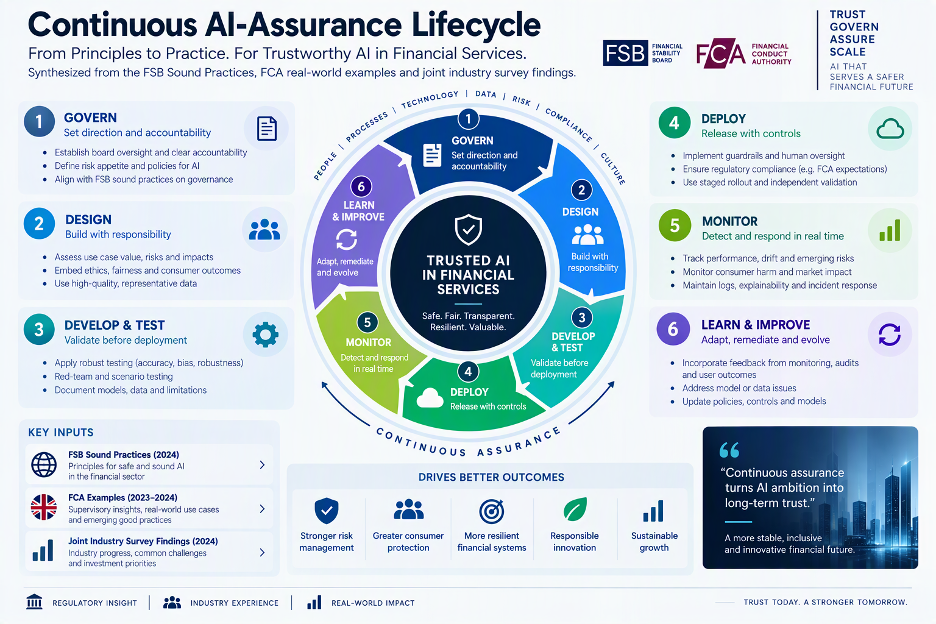
Continuous AI-assurance lifecycle synthesized from the FSB sound practices, FCA examples and joint survey findings. Source: Financial Stability Board, Source: Financial Conduct Authority, Source: Bank of England and Financial Conduct Authority
This is not a replacement for model-risk management, operational resilience or cybersecurity. It is the mechanism for integrating AI into all three.
Good Governance Is About Outcomes, Not Documentation Volume
The FCA’s October examples distinguish between controls that merely exist and controls that work.
| Strong practice | Weak practice |
| Define the customer problem and target market before selecting AI | Build the tool first, then search for a use case |
| Decide where AI may support, automate, abstain or escalate | Apply automation without clear intervention thresholds |
| Test outcomes across consumer characteristics and vulnerability scenarios | Exclude vulnerable customers by default |
| Give senior managers targeted information and explicit accountability | Delegate responsibility entirely to technical teams |
| Keep prompts, outputs, model versions, filters and escalation records | Maintain insufficient evidence to reconstruct a decision |
| Map model and provider dependencies to important business services | Treat third-party AI as a standard software purchase |
| Test failure, fallback and provider-exit scenarios | Depending on vendor assurances without independent challenge |
| Monitor live outcomes and recertify material systems | Treat pre-deployment approval as permanent |
Evidence table: operationally strong versus weak AI governance. Source: Financial Conduct Authority, Source: Freshfields Analysis
A technically accurate system can still generate a poor consumer outcome. A guardrail may reduce hallucination while making responses so generic that customers are directed toward unsuitable options. An automated journey may improve efficiency while preventing vulnerable customers from reaching meaningful support.
The board-level question is therefore not simply “Is the model accurate?” It is “Can the institution demonstrate that the complete service produces appropriate outcomes?”
Agentic Finance Raises the Identity Question
AI agents introduce a new layer between the institution and the customer. They may search for products, manage investments, initiate payments or transact with other agents.
That requires answers to four foundational questions:
- Identity: Which agent is making the request?
- Delegated authority: What has the customer or employee authorized it to do?
- Accountability: Which person or institution is responsible for the outcome?
- Execution: How can the receiving institution verify the instruction and its limits?
The FCA intends to work with industry, regulators and frontier-model laboratories on a trusted framework for agentic finance addressing these issues. Its October speech also states that significant AI failures and near-misses should fall within firms’ existing incident-reporting responsibilities. Source: Financial Conduct Authority
Until interoperable standards emerge, institutions should avoid treating an agent’s possession of valid credentials as sufficient proof of authority. Authentication answers “Who or what presented the credential?” It does not necessarily answer “Was this specific action authorized?”
Third-Party AI Is Now a Resilience Issue
The joint survey identified information security and operational resilience as the most prominent constraints on third-party AI adoption. The top three cloud and compute providers accounted for 79% of reported relationships, creating material concentration risk. Source: Bank of England and Financial Conduct Authority
Third-party governance must therefore extend beyond conventional procurement questionnaires.
Minimum assurance requirements
- Maintain an inventory of models, APIs, hosting services and embedded AI components.
- Link each dependency to the business services it supports.
- Track model updates and changes to safety or data-handling behavior.
- Establish measurable performance, security and availability thresholds.
- Retain audit and testing rights proportionate to materiality.
- Define data portability, model substitution and exit arrangements.
- Test fallback operations when the AI service is unavailable or unreliable.
- Require prompt notification of security incidents, major model changes and material control failures.
- Validate vendor claims through internal testing or independent assurance.
The FSB’s final practices explicitly place third-party performance, transparency, data quality, supply-chain exposure, concentration risk and business continuity within responsible AI adoption. Source: Financial Stability Board
Banking and FinTech Business Implications
Product strategy
AI use cases should begin with a customer or operational problem—not with pressure to deploy a fashionable capability. Materiality should increase with autonomy, financial consequences, customer vulnerability and difficulty of reversal.
Technology architecture
Banks need centralized AI inventories connected to identity, data governance, security telemetry, model-risk systems and operational-resilience maps. A spreadsheet maintained by one governance team will not remain reliable as agents proliferate.
Risk management
Existing frameworks can absorb many AI risks, but control thresholds must be adapted. An agent that can write code, communicate with customers or initiate a payment presents a different risk from a summarization assistant.
Procurement
Supplier assessments should examine model provenance, subcontractors, hosting concentration, updating practices, incident notification, explainability, security testing and exit readiness, not just contractual confidentiality.
Customer trust
Clear explanations, accessible human escalation and reliable complaint records will become competitive differentiators. Customers do not need a technical description of the model; they need to understand what the system can do, where its limits lie and how to challenge an outcome.
Opportunity: Governance as an Accelerator
Effective governance is often described as a constraint on innovation. The October evidence suggests the opposite.
A mature control model makes it easier to approve low-risk use cases, scale successful pilots and distinguish reversible experimentation from high-consequence automation. It also prevents every new proposal from being debated by first principles.
The most effective institutions will create reusable components:
- Standard risk tiers and approval pathways.
- Approved data and model patterns.
- Shared testing environments.
- Predefined human-escalation mechanisms.
- Agent identity and delegated-authority controls.
- Common monitoring and evidence standards.
- Tested provider-exit and fallback procedures.
This converts governance from a sequence of bespoke reviews into an operating platform.
Looking Ahead
During the next phase of financial-sector AI adoption, regulatory attention will shift from whether a firm has an AI policy to whether it can produce evidence from live systems.
Boards should expect greater scrutiny of:
- Materiality classifications.
- Third-party concentration.
- Post-deployment monitoring.
- Incident and near-miss reporting.
- Agent identity and delegated authority.
- Consumer outcomes across different customer groups.
- The institution’s ability to continue important services when AI fails.
The strategic dividing line will be between institutions that govern AI as a portfolio of production systems and those that continue to manage it as a collection of innovation projects.
Executive Takeaways
- AI governance is now an operating model, not a policy document.
- Close the post-deployment gap: monitoring, leakage testing and recertification need the same rigor as initial approval.
- Treat third-party AI as a material operational-resilience dependency.
- Build identity and delegated-authority controls before scaling agentic finance.
- Use risk-tiered, reusable controls to accelerate safe adoption rather than reviewing every use case from scratch.