


Why 2026 Marked a Turning Point for Cloud Strategy
For most of the past decade, cloud promised elasticity, speed, and cost efficiency. In 2026, that promise entered a more complex phase. As AI moved decisively from experimentation to production, it began to reprice the cloud.
AI workloads are fundamentally different from traditional enterprise systems. They are compute‑intensive, data‑hungry, and always on. As organizations embedded AI into core business processes, cloud spending accelerated and became far less predictable. What was once a flexible IT expense is now a material operating cost that draws CFO and board attention.
The strategic issue is not that cloud is becoming “too expensive.” It’s that cloud efficiency is no longer automatic. Many organizations are scaling AI faster than their ability to measure value, optimize workloads, or forecast costs. This gap is why FinOps has moved from a best practice to an executive requirement.
The leadership takeaway:
Cloud strategy in the AI era is financial strategy. Tech leaders must tie AI initiatives to clear business outcomes, strengthen cost governance, and make deliberate choices about where premium cloud infrastructure truly delivers advantage. The winners won’t be those who spend the most on AI—but those who spend with discipline.The New Economics of Cloud in the AI Era
At a Glance
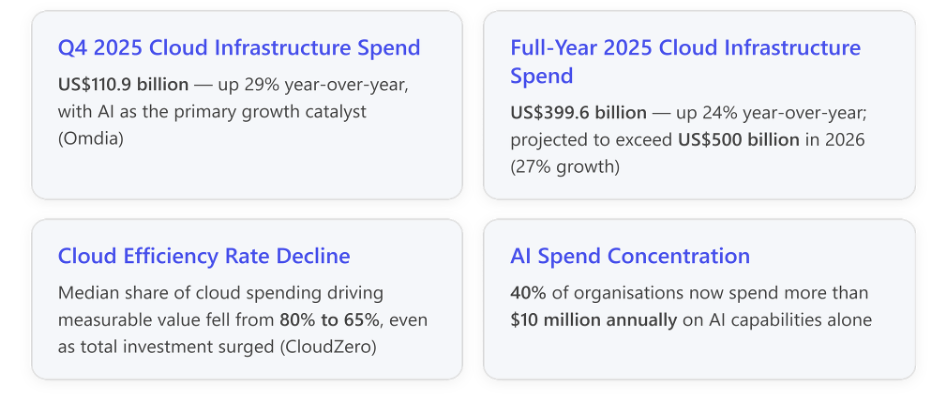
- AI is the primary driver of cloud spending growth in 2026, pushing quarterly infrastructure spending past US$110 billion.
- Full-year cloud infrastructure spending reached US$399.6 billion in 2025 (up 24% YoY), with Omdia projecting a further 27% rise in 2026 to exceed US$500 billion.
- Cloud efficiency is falling: the median share of spending that drives actual business value dropped from 80% to 65%, and over 20% of organizations report little visibility into how cloud costs relate to business outcomes.
- Pricing complexity is intensifying. AI workloads span storage, compute, data transfer, model training, and inference — making forecasting significantly harder for finance teams.
- FinOps is no longer optional — disciplined cost governance, workload tagging, and pricing negotiation are now executive requirements.
| Trend | Impact on Business | Leadership Action |
| AI-Driven Spend Surge — A single AI application can consume more resources than a traditional business system | Cloud budgets are growing 24–29% annually, turning cloud from a variable expense into a board-level operating cost | Treat cloud spends as a strategic KPI; mandate FinOps practices including resource tagging, reserved-instance procurement, and workload-placement analysis |
| Cost Unpredictability — Complex pricing across compute, storage, data transfer, training, and inference | CFO and board scrutiny rises as budget forecasting becomes unreliable; over 20% of organizations lack cost visibility | Invest in cost-attribution tooling; evaluate which AI workloads justify premium GPU infrastructure versus lower-cost alternatives |
| Efficiency Erosion — Median Cloud Efficiency Rate: 80% → 65% | More spending without proportional value gains threatens ROI on AI investments | Tie AI initiatives to clear business outcomes; re-architect or retire low-value workloads; consider AI-as-a-Service (AIaaS) to offload infrastructure complexity |