

You didn’t just scroll past a headline.
You clicked.
That tiny decision says more than you think.
It means you’re the kind of reader who still cares where information comes from, who wrote it, and whether it
holds up when you look a little closer. In a world where content is increasingly fast, automated, and
sometimes anonymous, that mindset is becoming a competitive advantage.
So welcome. This is the official ITS Blog, and this is the moment we stop leaving our story to chance.
In this article:
- The day “information” stopped feeling reliable
- The crisis behind most corporate communication
- The decision: build a place for clarity (and a more human touch)
- What you can expect here
- Why now?
The day “information” stopped feeling reliable
We’ve entered an era where you can read something perfectly written… and still wonder if a real human stood
behind it.
AI has made publishing easier, faster, and cheaper, which is exciting. It has also made it easier to flood the
internet with confident claims, recycled ideas, and “expert” commentary that isn’t credited, tested, or
accountable.
And in industries like fintech, cloud, cybersecurity, and enterprise technology, the cost of misinformation isn’t
just confusion. It’s risk.
The truth is: the more complex the technology, the more the world needs translators, people who can take
what’s happening behind the scenes and turn it into something decision-makers can actually trust.
That’s the gap we’re stepping into.

“The real question isn’t whether to change — it’s how
to change with confidence.”
— Fahad Al-Menayes, CEO at ITS
The crisis behind most corporate communication
Most companies face a quiet dilemma:
- Stay technical, safe, and structured — and risk sounding like everyone else.
- Or speak more openly — and risk being misunderstood, misquoted, or oversimplified.
For years, most corporate communication has tried to solve this by compressing everything into short
updates: a launch post, a milestone announcement, a few polished lines on a website.
But that approach has a limit. Because real progress doesn’t happen in slogans. It happens in the decisions,
trade-offs, lessons learned, and evolving ideas that never fit inside a single caption.
At ITS, our work has always started where most people don’t look: the systems, the code, the infrastructure, the
back end.

As our Marketing & Communications Manager
Patrichia Kahawati put it:
“ITS starts from the back end.”
That back end is often invisible. But it’s where trust is built.
So we asked ourselves a direct question:
If the world is getting noisier, more automated, and easier to fake… what would it look like to build a space that
does the opposite?
The decision: build a place for clarity (and a more human touch)
That decision is this blog.
Not as a marketing trend. Not as “content for content’s sake.” But as a platform with a clear purpose: to speak
to our community in a more human way, through stories, perspectives, and practical insight.
Because a blog can do something a website or newsletter usually can’t.
To borrow a line directly: “A blog is usually closer to you than a website or a newsletter.”
It can invite discussion. It can include opinion. It can explain context. It can disagree with itself, evolve, and
sharpen over time, like the industries we work in.
And it’s also a signal of what we believe the future of credible content should look like:
- Named voices
- Real experience
- Clear accountability
- A point of view grounded in practice
This matters even more because ITS operates across a broad portfolio of technology solutions, serving
organisations that depend on resilient operations and secure systems.
What you can expect here
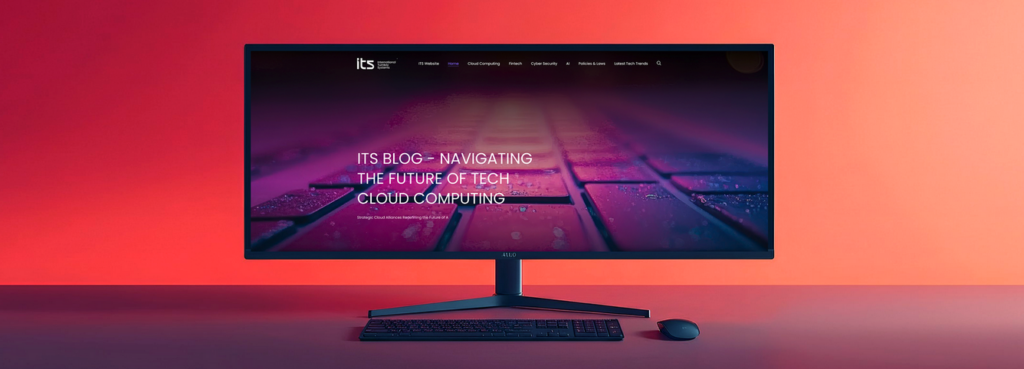
This blog will cover the topics our clients, partners, and community actually deal with, not just what trends for
a week.
You’ll see writing across areas including:
- Fintech
- Cloud Computing
- Cyber Security
- AI
- Policies & Laws
- Latest Tech Trends
And you’ll hear from people who live this work, including voices from inside ITS, and also experts and
influencers outside ITS who are relevant to our industry.
Because we’re not trying to be a news agency. We’re building something more useful: a hub where
practitioners share what they’ve learned, what they’re seeing, and what decision-makers should pay
attention to next.
Why now?
Because trust is becoming the main differentiator.
ITS has built its brand around the idea that progress isn’t the enemy, uncertainty is. That’s why “Trust in
Change” isn’t treated as a decorative tagline; it’s a message about continuity: evolving while staying
dependable.
And when you zoom out, the intent is simple:
- Depth: acknowledging the complexity behind the screen
- Clarity: structuring information so people can act on it
- Humanity: keeping people at the centre of every technology story
This blog is one more way we live that philosophy — publicly, consistently, and with substance.
If you’re reading this, you’re not here by accident.
You’re here because you care about technology and our modern world, and you care about making sense of
it. You might be building strategy, leading transformation, managing risk, running operations, launching
products, or simply staying sharp in a world that moves fast.
Either way, you’re in the right place.
So here’s our invitation:
- Read with curiosity.
- Disagree when you need to.
- Share what’s worth sharing.
- And come back when you want insight you can actually use.
Because the future won’t just belong to the people who publish the most.
It will belong to the people who publish what’s true, and can stand behind it.
Welcome to the ITS Blog