

From Strategic Flexibility to Operational Reality
The question “Should we go multi-cloud?” is now obsolete. In 2026, multi-cloud is the operating model, not an aspiration.
Enterprises adopted multiple clouds for good reasons: avoiding vendor lock‑in, optimizing workloads, improving resilience, and meeting regulatory or sovereignty requirements. Governments and regulated industries are accelerating this shift as data control and jurisdiction become strategic concerns.
But flexibility comes with a cost. Every additional cloud increases complexity—more tools, more integrations, more policies, and more ways things can break. Without strong governance, multi-cloud environments can quietly erode efficiency, security, and speed.
This is why platform engineering has emerged as a critical leadership investment. By standardizing access, tooling, and workflows across clouds, internal platforms turn multi-cloud from a liability back into an advantage.
The leadership takeaway:
Multi-cloud success is no longer about vendor selection—it’s about execution. Leaders should focus less on choosing clouds and more on governing them, investing in platforms, clear policies, and workload discipline. In 2026, governance—not access—is the real source of cloud agility.
Flexibility vs. Complexity in Cloud Strategy
At a Glance
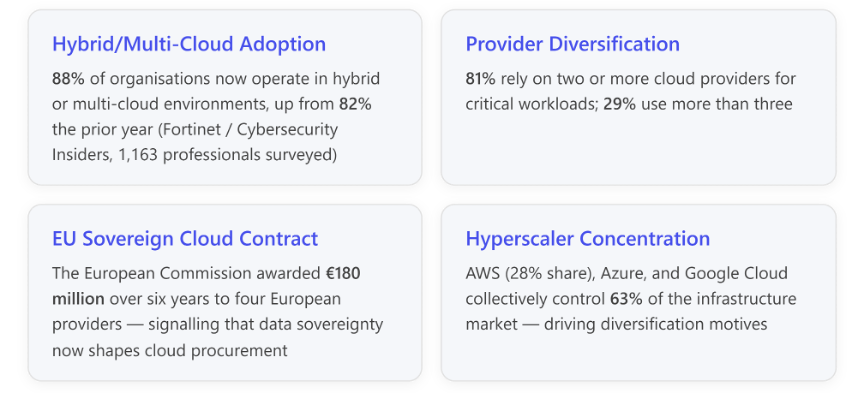
- 88% of organizations operate hybrid or multi-cloud environments, up from 82% the prior year, with 81% using two or more providers and 29% using more than three.
- Sovereignty is accelerating diversification. The European Commission awarded a €180 million, six-year sovereign cloud contract to Post Telecom, StackIT, Scaleway, and Proximus.
- US-based providers hold approximately 70% of the European cloud market, driving EU institutions to invest in local alternatives under the Cloud Sovereignty Framework.
- Operational complexity is the hidden cost. Each additional platform adds tools, integrations, and credential dependencies — creating overhead governance that erodes the flexibility gains.
- Platform engineering is the stabilizer. Internal developer platforms that standardize access across clouds are shifting from optional to essential.
| Trend | Impact on Business | Leadership Action |
| Multi-Cloud Mainstream — 88% adoption, 81% using 2+ providers | Broad flexibility and resilience, but fragmented operations and rising management overhead | Invest in unified management and platform engineering to standardise multi-cloud access |
| Data Sovereignty — €180M EU contract to four European providers; CADA legislation forthcoming | Provider diversification driven by regulatory mandate, not just preference; global cloud becomes regionally segmented | Track sovereignty rules closely; evaluate sovereign cloud options if operating in or serving European markets |
| Regulatory Acceleration — EU AI Act (August 2026), NIS2, DORA, EU Product Liability Directive (end of 2026) | Compliance complexity compounds operational burden; affects data handling, AI deployment, and liability exposure | Audit cloud environments against upcoming regulatory requirements; assign compliance ownership across provider boundaries |