
Executive summary
Cloud capacity planning has become energy planning. On 19 October Microsoft confirmed it had pulled out of a UK AI data-center deal with Nscale at Loughton, northeast of London, after UK media reported that grid officials had told Nscale the site would not have power until the 2030s. The site had been described by the former prime minister as the largest UK sovereign AI data center and was due to open in 2027. The same company is, by Bloomberg’s account as reported by Data Center Dynamics, planning to more than triple its global data-center capacity to 38GW by 2032. The gap between those two facts is the defining risk of the next cloud cycle: hyperscalers can fund capacity faster than grids can connect it. For enterprise buyers, capacity, price and location are no longer guaranteed by a vendor’s balance sheet; they depend on substations and transmission timelines.
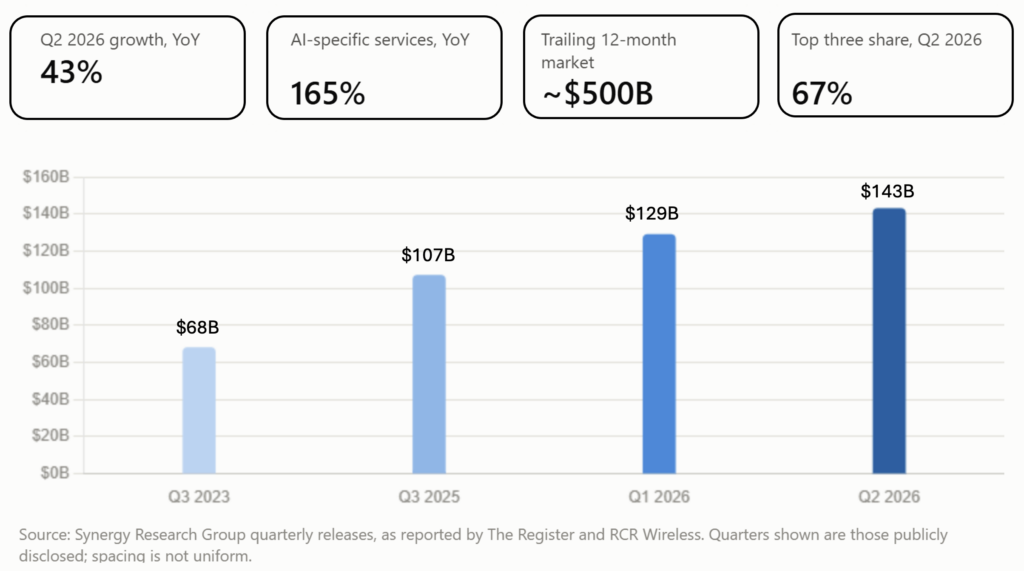
Key statistic: AI-specific cloud services grew 165% year-on-year in Q2 2026, inside a cloud infrastructure market that grew 43% to over $143 billion for the quarter, according to Synergy Research.
The development
The exit. The Loughton lease was announced in 2025 alongside a wave of US technology investments during a presidential state visit to the UK. UK Power Networks told AFP that many data centers can connect to its distribution network but are awaiting work on the national transmission network, which it does not own. Nscale said it remains committed to the Loughton project, is exploring alternative power sources, and that the grid issue has no impact on its other contracts. The Loughton deal accounted for only a small portion of Microsoft’s agreements with Nscale, according to a person familiar with the matter cited by AFP.
The commitment. Microsoft’s UK chief said the company’s $30 billion UK investment plan for 2025–2028 will not change and that it remains committed to Nscale at sites outside the UK. The pattern is not isolated: earlier in 2026 OpenAI also withdrew from a partnership with Nscale and Nvidia to establish a UK version of Stargate.
The scale. Microsoft’s reported 38GW target, up from about 12GW today, would combine owned and leased capacity, including from neoclouds such as CoreWeave, Nscale, Lambda, Iren and Nebius; the company brought 88 data centres online in FY2026 and would need to average just over 1GW of new capacity per quarter to reach the target. Microsoft has not publicly confirmed the figure.
The chart below shows how fast the demand side has moved.
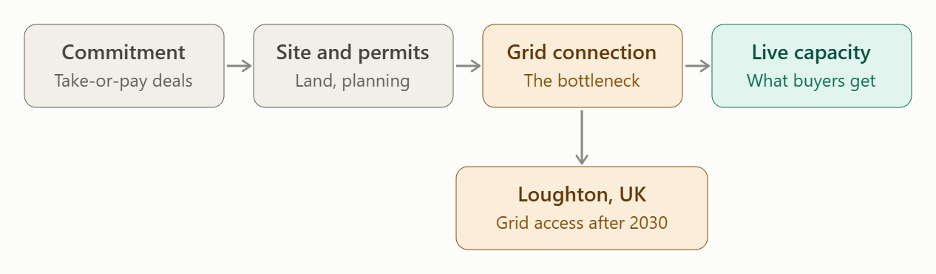
A funded, politically backed site with a signed anchor tenant can still stall for years at the grid stage.
Industry impact
The economy is shifting from elastic consumption to pre-committed capacity. Server shortages reportedly forced Microsoft to turn away some cloud and AI customers; Azure constraints reportedly pushed workloads to rivals, limited Xbox cloud streaming and forced GitHub to shift some AI traffic to AWS. For buyers this cuts both ways: large customers may be favored when capacity is tight, while smaller workloads compete for what remains. Capital is following the constraint: data-center investment helped drive Blackstone to record assets this quarter.
How capacity is being secured, and what each model exposes:
| Model | Example | Flexibility | Exposure |
| Owned hyperscale build | Microsoft Fairwater sites; 2GW Pecos, Texas campus | Low | Grid, permitting, capex |
| Leased neocloud capacity | Microsoft–Nscale, Core Weave contracts | Medium | Counterparty concentration; Nscale reportedly earns over 40% of revenue from Microsoft |
| Sovereign or regional provider | Scale way (France), Malaysia sovereign AI cloud | Medium | Smaller service catalogues, scale |
| Enterprise reserved capacity | Reserved instances, committed-use discounts | Low for buyer | Paying for capacity the provider may not energize on time |
Banking and FinTech Relevance
- Capacity is a counterparty risk. Banks depending on a single region for AI inference should model the scenario in which that region is constrained, as Azure customers experienced in 2026.
- Residency commitments depend on energized sites. The UK case shows a “sovereign” facility can slip by years. Residency architectures need fallback regions within the same jurisdiction, a point the September ITS sovereign-cloud article made from the control-model side.
- The GCC’s advantage is structural. Energy availability and coordinated planning are precisely the inputs that failed at Loughton; the region’s ability to connect large loads quickly is a competitive asset for attracting AI capacity, provided chip access holds.
- A financing opportunity. Grid upgrades, behind-the-meter generation and neocloud expansion are capital-hungry; project-finance and infrastructure-lending desks are already active.
Insight: A hyperscaler’s commitment to a region is no longer a promise about servers. It is a bet on a grid-connection date the hyperscaler does not control.
Enterprise implications and opportunities
- Reserve don’t assume. Treat AI capacity like a long-dated supplier contract with explicit regional fallbacks.
- Ask for energized capacity by region, not announced capacity, in vendor due diligence.
- Negotiate capacity service levels. Volume commitments should be matched by provider-side guarantees, not only discounts.
- Use regional and sovereign providers tactically as inference pressure valves rather than wholesale replacements.
Risks and challenges
- Forecast whiplash. Capacity plans have reversed within months before; the same company that is tripling capacity reportedly walked away from about 2GW of planned projects earlier in 2026 on oversupply concerns.
- Sustainability credibility. Microsoft reported a 25% year-over-year increase in emissions tied to data-center electricity against a 2030 carbon-negative pledge.
- Concentration of fixed obligations. Take-or-pay commitments between AI developers, neoclouds and hyperscalers create a chain in which one party’s revenue shortfall becomes another’s stranded capacity.
Outlook
Expect capacity announcements to be judged by energized dates rather than gigawatt headlines; growth to tilt toward regions with faster grid access (the US Sun Belt, the Nordics, the Gulf, parts of Southeast Asia); and a wave of behind-the-meter and nuclear offtake arrangements. For enterprises, the AI-infrastructure planning horizon is stretching from quarters to years.
Executive takeaways
- Add energy and grid risk to cloud-vendor due diligence; ask for energized, not announced, capacity.
- Build regional fallbacks inside each jurisdiction to protect data-residency commitments against site delays.
- Govern capacity reservations as strategic supplier contracts, with board visibility.
- Watch the take-or-pay chain across AI developers, neoclouds and hyperscalers as a systemic-risk indicator.
- For GCC institutions, treat regional energy and connection speed as a strategic lever, and look for financing roles in the build-out.