

Executive summary
The vulnerability-management problem is changing.
Organizations once worried primarily about discovering vulnerabilities quickly enough. Today, many security teams face the opposite challenge: too many findings competing for limited remediation capacity across an expanding technology estate.
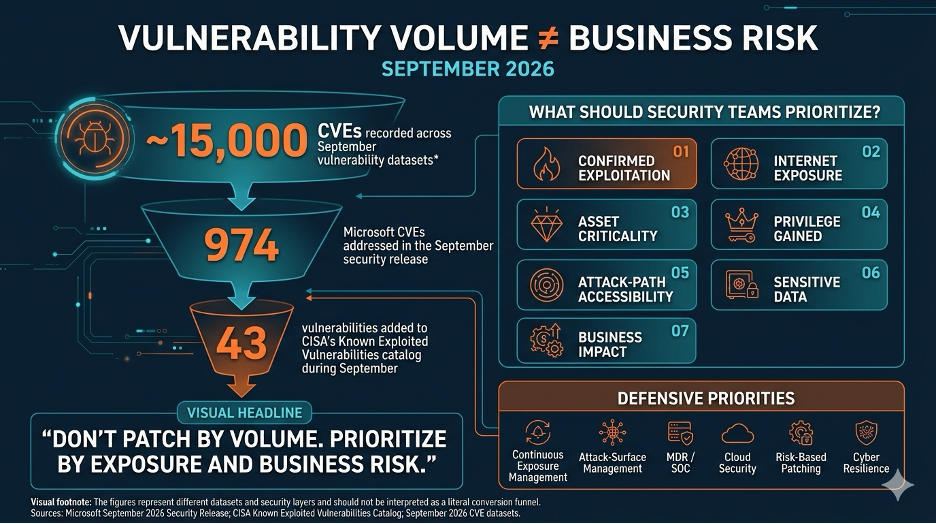
Microsoft’s September 2026 security release addressed approximately 974 CVEs, while September vulnerability datasets recorded roughly 15,000 CVEs, depending on methodology and snapshot timing.
Yet only a fraction of disclosed vulnerabilities carry evidence of active exploitation.
During September, 43 vulnerabilities were added to CISA’s Known Exploited Vulnerabilities catalog.
The contrast exposes the central weakness of volume-driven patch management:
A large vulnerability backlog does not tell security leaders where the next material incident is most likely to begin.
September’s vulnerability signal
| Signal | What it measures | Decision value | Limitation |
| CVE volume | Published vulnerabilities | Shows disclosure pressure | Does not establish organizational exposure |
| CVSS | Technical severity | Helps assess potential technical impact | Does not confirm exploitation |
| EPSS | Exploitation probability signal | Adds threat likelihood context | Does not measure business impact |
| CISA KEV | Confirmed exploitation | Strong remediation-priority signal | Does not show whether the asset exists internally |
| Asset criticality | Business importance | Connects technology to business impact | Does not establish exploitability |
| Attack-path analysis | Potential attacker movement | Shows possible blast radius | Requires accurate asset and identity context |
The implication is straightforward:
No single vulnerability metric is sufficient for prioritization.
From vulnerability management to exposure management
Traditional programs often follow:
Discover → Score → Patch → Close
A more risk-oriented model becomes:
Discover → Validate Exposure → Check Exploitation → Map Attack Path → Assess Business Impact → Remediate → Verify → Hunt
The difference is important.
A critical vulnerability on an isolated development asset may represent less immediate risk than a lower-scoring vulnerability affecting an internet-facing identity platform, remote-management system or payment environment.
What changes for banks and enterprises?
1. Patch counts become a weak executive KPI
Reporting that 95% of vulnerabilities were patched says little about the risk represented by the remaining 5%.
2. Identity context becomes part of vulnerability management
Security teams need to understand what privileges an attacker could obtain after exploiting an asset.
3. Remediation and detection must work together
Where exploitation may have occurred before patching, remediation should be accompanied by compromise assessment and threat hunting.
The GCC/MENA perspective
Rapid digitization across GCC/MENA is expanding the number of internet-facing applications, APIs, fintech integrations, cloud workloads and interconnected services that organizations must monitor.
For regulated institutions, vulnerability management therefore increasingly intersects with:
- operational resilience;
- third-party risk;
- critical-service availability;
- identity security;
- cloud security; and
- incident-response readiness.
The regional opportunity is not simply to automate patch deployment.
It is to build continuous exposure visibility capable of connecting technical weaknesses to business-critical services.
Strategic priorities
- Use confirmed exploitation as a major prioritization signal.
- Maintain accurate asset and external-exposure inventories.
- Add business criticality to remediation decisions.
- Map vulnerabilities to identity privilege and attack paths.
- Integrate vulnerability intelligence with MDR/SOC telemetry.
- Verify remediation rather than assuming patch deployment equals risk removal.
- Conduct compromise assessment where exploitation may predate remediation.
Executive takeaway
The vulnerability challenge is no longer scarcity of information—it is scarcity of attention. Security leaders need to know which exposure deserves the next hour of remediation effort, not simply how many vulnerabilities remain open.