
Meta description: AI infrastructure expansion is accelerating worldwide. Discover what new cloud regions, data centers and AI capacity mean for enterprise strategy, banking transformation and GCC/MENA decision-makers.
Executive summary
Artificial intelligence may live in software, but its next chapter is being built in the physical world.
PwC’s central scenario forecasts that annual global data-center capital expenditure could rise from approximately US$800 billion in 2026 to US$1.1 trillion in 2030 and US$1.8 trillion by 2050. Meanwhile, the International Energy Agency projects data-center electricity consumption to increase from approximately 415 TWh in 2024 to 945 TWh in 2030. Both are forecasts—not measures of completed investment or capacity—and both underlines how closely AI growth is becoming tied to power, facilities and hardware.
September’s infrastructure signals
Four announcements illustrate the different forms this expansion is taking. Their figures are deliberately not ranked because an operational region, investment commitment, capacity target and quarterly delivery are not directly comparable.
| Provider development | Geography and date | Verified status | What the figure represents |
| Microsoft India South Central | Hyderabad; highlighted 21 September 2026 | Operational three-zone region; additional services will roll out progressively | Part of Microsoft’s stated US$20.5bn India commitment, not a disclosed region-level construction cost Microsoft |
| Google Finland programme | Finland; announced 9 September 2026 | Future investment commitment covering 2027–2028 | €13bn for digital infrastructure, clean energy and partnerships; includes a contracted 94 MW battery systemblog+1 |
| Alibaba Cloud expansion | Global; announced 23–25 September 2026 | Planned over the following 12 months | First regions planned in Türkiye, Finland and the Netherlands; UAE and four other markets to gain added data-center footprint. Alibaba also stated a greater-than-20 GW global capacity target for 2032 |
| Oracle Q1 FY2027 delivery | Global company disclosure; 10 September 2026 | Company-reported delivered capacity | Oracle reported 850 MW of additional data-center capacity and more than 300,000 GPUs delivered since the end of Q4 |
The pattern is broader than a race to acquire accelerators. Microsoft’s September infrastructure analysis describes silicon, memory, networking and power as interconnected constraints, while PwC identifies power availability, connectivity, security, GPU access and policy certainty as factors determining where AI infrastructure investment can be captured.
The following original infographic translates that relationship into an enterprise and banking context.
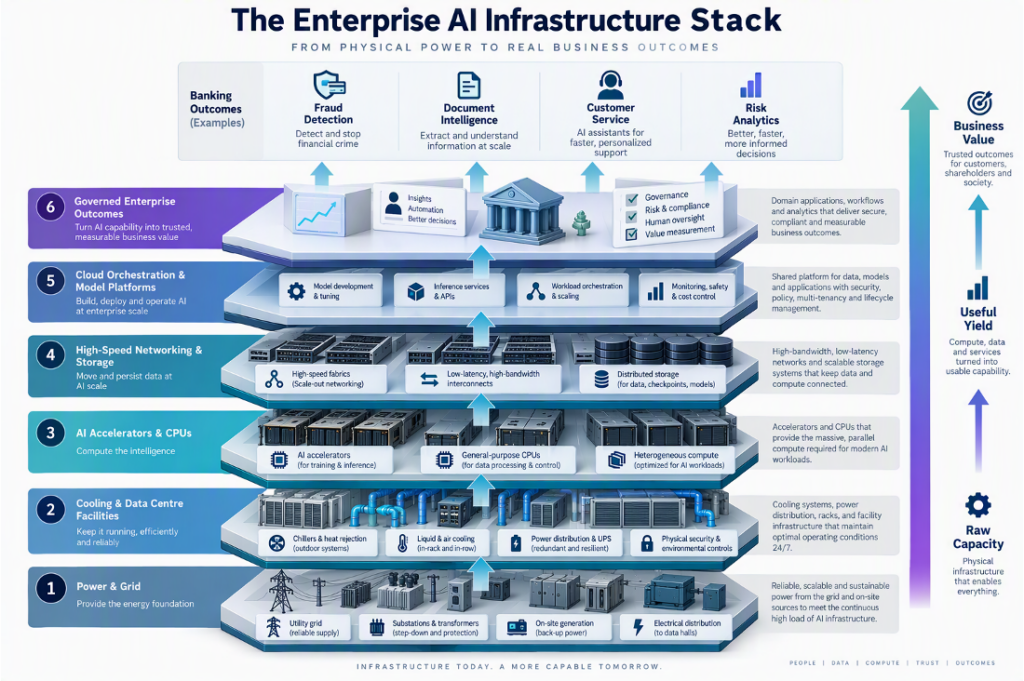
AI infrastructure creates value only when power, facilities, silicon, networking, platforms and governance operate as one system.
From raw capacity to “useful yield”
Buying more infrastructure is not the same as producing more value. Microsoft has proposed “useful yield” as a way to consider how efficiently silicon, memory, networking and power translate into productive intelligence—through measures such as throughput, latency and tokens per dollar or watt.
For enterprises, the underlying principle is vendor-neutral: measure infrastructure by the governed business outcome it enables. A bank could monitor cost per document processed, fraud alert investigated, customer interaction completed or software task accepted—not only GPUs provisioned or tokens consumed.
What changes are these for banks and enterprises?
1. Capacity planning becomes workload planning
Fraud monitoring, document intelligence, customer-service assistants, regulatory reporting and model training have different latency, data, resilience and processing requirements. The IEA also shows that servers, storage, networking and cooling consume different shares of data-center electricity, reinforcing the need to evaluate the full system rather than compute alone.
Technology leaders should classify workloads by:
- Real-time versus batch execution
- Training, fine-tuning or inference
- Data sensitivity and required processing location
- Availability and recovery requirements
- Expected cost per business outcome
2. A local region is not a complete service catalogue
Microsoft states that additional Azure and AI services will be introduced progressively in India South Central. Google similarly advises customers to verify product availability by region because regionally available and globally available services may have different location characteristics.
Banks should therefore verify where data, prompts, embeddings, model outputs, logs, backups and administrative metadata are processed—instead of assuming that every service inherits the location of the selected region.
3. AI economics becomes a governance discipline
PwC forecasts that recurring ICT refreshes—not building construction alone—will drive much of long-term data-center expenditure, because servers, GPUs, storage and networking equipment require replacement. Oracle’s quarterly disclosure also shows how capacity delivery, GPU deployment and infrastructure revenue are increasingly connected.pwc+1
Useful executive metrics include:
| Metric | Decision it supports |
| Cost per completed AI outcome | Whether the use case can scale economically |
| Accelerator utilization | Whether expensive resources are productive |
| Inference latency and throughput | Whether performance matches the process |
| Storage and data-transfer cost | Whether architecture creates avoidable expense |
| Regional service availability | Whether residency and resilience needs can be met |
| Recovery and portability testing | Whether concentration risk is controlled |
The GCC/MENA opportunity
PwC’s scenario analysis identifies the Middle East as a region where energy, capital and coordinated planning could support data-center growth, while also noting that chip-access disruption could disproportionately affect AI-heavy regional pipelines. This makes infrastructure access, energy strategy, sovereignty and workload economics interconnected board-level questions.