

AI has turned cloud infrastructure into a strategic capacity market. Here is what business and technology leaders should know about hyperscaler investment, AI workloads, FinOps, and cloud resilience in 2026.
Executive summary
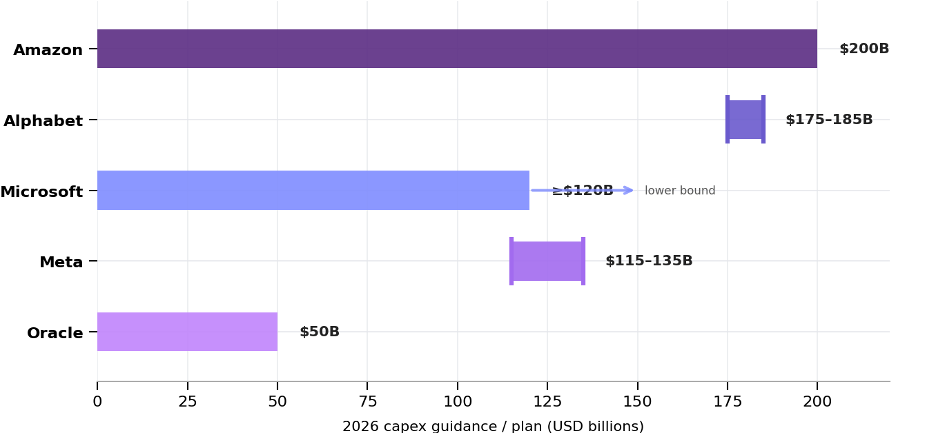
AI is changing the economics of cloud computing. What used to be a conversation about storage, virtual machines, and application hosting is now a board-level discussion about computing capacity, data-center power, specialized chips, model platforms, and operational control. Futurum reports that Microsoft, Alphabet, Amazon, Meta, and Oracle have collectively committed roughly $660–690B in 2026 capital expenditure, with spending directed heavily toward AI compute, data centers, and networking.
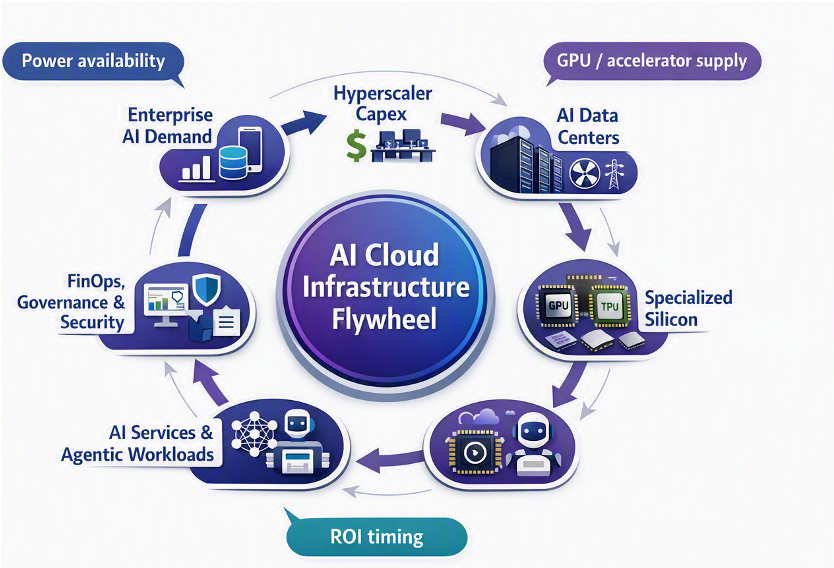
For business leaders, this means cloud strategy is no longer only about choosing a provider. It is about securing access to the infrastructure layer that will power AI-enabled products, customer experiences, operations, and decision-making. For IT leaders, it means cloud architecture must now account for workload placement, inference economics, model governance, power constraints, and cost transparency in one connected operating model. Cisco describes AI in cloud computing as the integration of AI technologies into cloud-based environments, enabling data-driven decision-making, automation, predictive analysis, and scalable resource use.
AI Infrastructure Capex Sprint 2026
(Ranges reflects Public Guidance/Estimates)
Why the AI cloud boom matters now
The AI cloud boom is not simply a spending race among technology giants. It reflects a structural shift in enterprise demand. Organizations are moving from experimentation to production AI: copilots, intelligent automation, predictive analytics, AI-assisted software development, fraud detection, customer-service automation, and industry-specific AI workflows. Cloudwards notes that AI transforms cloud environments by enabling automation, real-time decision-making, deep data analysis, smarter resource management, AIOps, and improved security detection.
That shift creates a new dependency: enterprises need reliable access to AI-ready infrastructure. Hyperscalers are building ahead of demand because AI workloads consume large volumes of computers, networking, storage, and power. Futurum also notes that the largest hyperscalers describe the market as supply-constrained rather than demand-constrained, with Microsoft’s unfulfilled Azure backlog tied largely to power availability.
From cloud migration to capacity strategy
For years, cloud modernization was often framed as a migration question: which workloads should move from on-premises environments to public, private, or hybrid cloud? In 2026, the more strategic question is: which workloads deserve scarce AI-grade capacity, and where should they run?
Training large models, fine-tuning industry models, running high-volume inference, and operating AI agents are not identical workloads. Some require GPU clusters. Others can run more economically on cloud-native silicon or optimized CPUs. Some must remain close to data for governance reasons. Others can be placed in public cloud regions for scale. This makes workload classification a strategic discipline, not a technical afterthought.
What changes for business leaders
The first change is financial. AI workloads can make cloud spend less predictable because usage spans compute, storage, networking, model APIs, managed services, and observability. ITS’s own cloud-hosting trend material already identifies FinOps as a rising priority, noting that cloud cost governance has moved from a technical concern to a strategic board-level issue.
The second change is competitive. Companies that secure the right capacity, governance, and cost controls can deploy AI-enabled services faster. Companies that treat cloud as a generic utility may face delays, cost spikes, or compliance friction.
The third change is regional. ITS’s internal MENA cloud hosting analysis highlights policy-driven cloud acceleration, sovereign cloud adoption, BFSI migration, telco edge expansion, and surging AI-hosting demand across the region. For organizations in regulated markets, cloud strategy must include data residency, sovereign infrastructure, and industry-specific compliance from the start.
What IT teams should do next
- Map AI workloads by compute profile. Separate training, fine-tuning, real-time inference, batch inference, analytics, and agentic workflows.
- Build a cloud-capacity forecast. Estimate computing, storage, network, and model-consumption requirements before scaling pilots into production.
- Strengthen FinOps. Move from monthly cloud-cost reviews to real-time unit-cost dashboards and anomaly alerts.
- Diversify workload placement. Use hyperscalers for enterprise integration, governance, and global reach; evaluate specialized AI infrastructure where GPU economics or accelerator availability matter.
- Add governance early. Model access, data lineage, security controls, policy enforcement, and audit trails should be designed before AI adoption accelerates.
Conclusion
AI is turning cloud infrastructure into the enterprise power grid of the digital economy. It supports applications, decisions, customer journeys, automation, and innovation. But like any power grid, it must be planned, governed, monitored, and optimized. The winners will not simply be the organizations that “use AI.” They will be the organizations that understand where AI runs, what it costs, how it is governed, and how resilient the infrastructure behind it truly is.
Explore how ITS helps organizations modernize infrastructure, strengthen cloud governance, and prepare for AI-ready digital transformation.