

Meta description: Cloud and AI investment across GCC/MENA is accelerating. Learn how to distinguish investment announcements from operational capacity—and what the shift means for banks, regulators and technology leaders.
Executive summary
The GCC cloud story is moving from market-entry announcements to a more demanding phase: building, activating and proving locally usable capacity.
On 23 September 2026, Microsoft announced plans to invest more than US$10 billion in capital and operating expenditure across Kuwait, Qatar, Saudi Arabia and the UAE through 2030, plus more than US$400 million for subsea and terrestrial connectivity. The announcement does not provide a country-level spending breakdown or convert the commitment into disclosed megawatts of operational capacity.
The correct interpretation is therefore: a multi-year regional commitment—not US$10 billion of live cloud capacity.
Infrastructure spending is accelerating
Gartner forecasts total MENA IT spending of US$169.0 billion in 2026, an increase of 8.9% from its 2025 forecast. Data-center systems are forecast to be the fastest-growing segment, rising 37.3% to approximately US$13.0 billion. Gartner attributes much of that growth to governments, hyperscale’s, technology providers and organizations developing or deploying AI models.
| MENA segment | 2025 forecast | 2026 forecast | Forecast growth |
| Data-center systems | US$9.455bn | US$12.984bn | 37.3% |
| Software | US$17.949bn | US$20.452bn | 13.9% |
| IT services | US$34.061bn | US$36.894bn | 8.3% |
| Communications services | US$60.905bn | US$63.456bn | 4.2% |
| Total IT | US$155.163bn | US$169.019bn | 8.9% |
All figures are for the Gartner forecasts, not actual expenditure.
Operational capacity and future capacity are different
| Regional development | Status at 30 September 2026 | Evidence-based interpretation |
| Google Cloud Doha | Operational since 2023 | Three-zone region launched with selected compute, database and platform services |
| Google Cloud Dammam | Operational since 2023 | Local KSA region with region-specific access and partner-operated sovereignty options |
| Microsoft Saudi Arabia East | Planned for November 2026 | Three availability zones announced; not yet generally available on 30 September |
| AWS Saudi Arabia Region | Planned for December 2026 | More than US$5.3bn in planned infrastructure investment; separate commitment of up to 50 MW for an AI Zone by 2028 |
| Microsoft Gulf programme | Commitment through 2030 | More than US$10bn of combined capital and operating expenditure across four countries—not disclosed current capacity |
| Alibaba Cloud UAE expansion | Planned over 12 months | Additional UAE data-center footprint announced without a disclosed local capacity figure |
The following flywheel shows how regulation, investment, infrastructure and adoption reinforce one another—while keeping live services separate from future commitments.
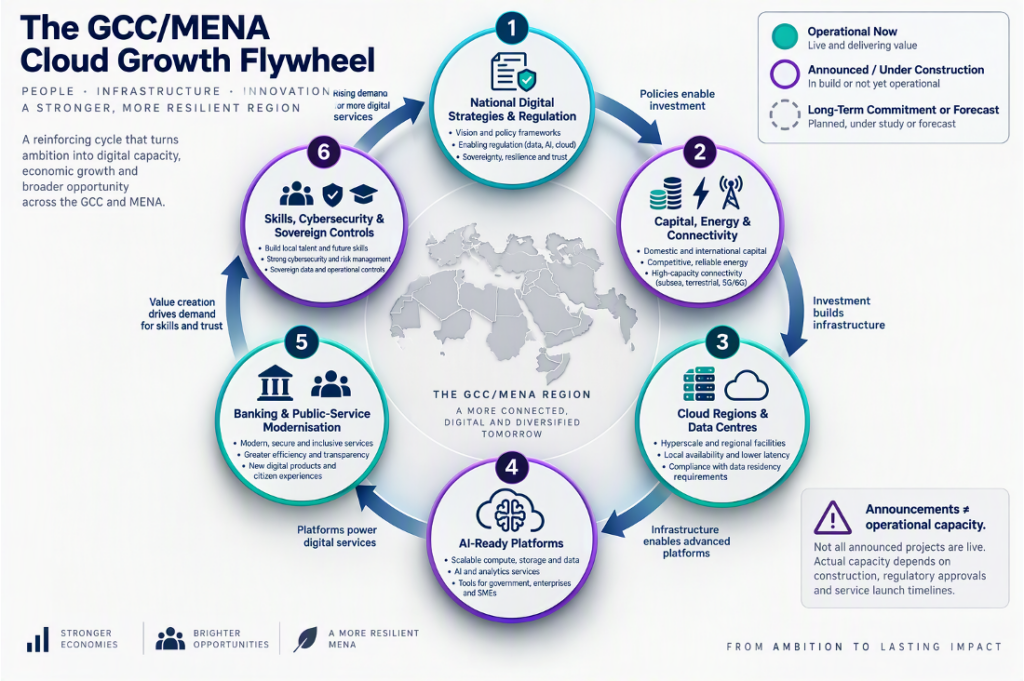
Regional cloud growth is a reinforcing cycle—but announced investment, constructed infrastructure and live service capacity must be assessed separately.
Why banking will shape regional demand
Data residency and approval
QCB requires PII and financial information to be processed within Qatar and calls for regulatory approval, cloud registers, audit rights, continuity arrangements and tested exit plans. UAE standards similarly retain accountability with bank boards and require due diligence, data protection, supervisory access and management of concentration risk.
Local infrastructure can support compliance, but it does not guarantee it. Banks must verify the location and operating model of each database, AI service, backup, log, key-management system and support function.
AI adoption
Regional infrastructure demand is increasingly linked to AI-enabled software, advanced machine learning and data-intensive services. Gartner’s forecast supports that direction, while PwC highlights the Middle East’s strength in coordinated capital, energy and planning—and its exposure to constrained access to advanced chips.
For banks, the most promising workloads include document processing, fraud analytics, customer-service automation, software engineering and controlled use of enterprise knowledge. Their placement should depend on data sensitivity, latency, service availability and tested resilience—not market announcements alone.
Sovereign-cloud opportunity
The region’s opportunity extends beyond constructing data centers. It includes:
- Regulated workload classification and migration
- Sovereign landing zones and external key management
- Local managed security and cloud operations
- AI-ready banking data platforms
- Cloud registers and continuous compliance evidence
- FinOps and AI unit-cost governance
- Business-continuity and stressed-exit testing
- Regional cloud, AI and cybersecurity skills
These opportunities follow directly from the control expectations in QCB and CBUAE regulations and from the increasing variety of regional cloud and sovereign-partner models.