
Executive summary
Artificial intelligence is changing cybercrime less by inventing entirely new attacks than by removing the constraints that once limited them.
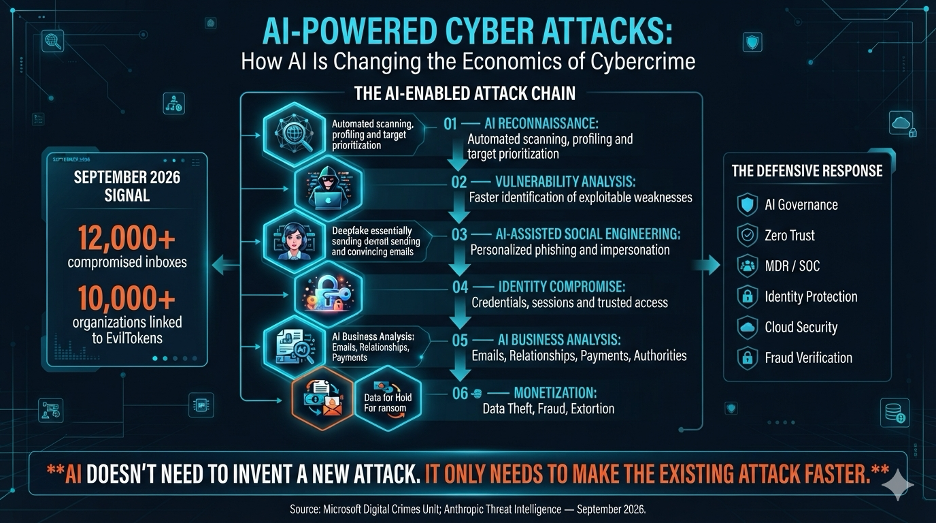
Reconnaissance can be accelerated. Vulnerabilities can be analyzed faster. Stolen communications can be interpreted at scale. Social-engineering messages can become more contextual. Malware and attack tooling can be adapted more quickly.
September 2026 provided important evidence that this transition is already underway.
Anthropic documented malicious actors using AI across activities including reconnaissance, vulnerability research, exploitation, credential harvesting, malware modification and data exfiltration. Microsoft, meanwhile, linked the EvilTokens cybercrime service to more than 12,000 compromised inboxes across over 10,000 organizations, showing how AI could help criminals analyze stolen communications and identify financially valuable relationships.
The strategic issue is therefore not whether AI will replace human attackers.
It is whether AI allows attackers to operate faster, across more targets and with greater business context than traditional security processes can comfortably absorb.
September’s signal: AI is moving deeper into the attack lifecycle
The most important development is the widening role AI can play after an attacker selects a target.
| Attack stage | Traditional approach | AI-enabled change | Why it matters |
| Reconnaissance | Manual research and scanning | Automated profiling and prioritization | More targets can be assessed simultaneously |
| Vulnerability research | Specialist-led analysis | AI-assisted analysis and experimentation | Discovery and exploitation cycles may shorten |
| Social engineering | Generic or manually customized messages | Context-aware personalization | Fraud attempts can become more convincing |
| Tool adaptation | Manual modification | AI-assisted code and technique adaptation | Attackers can respond faster to defensive controls |
| Compromised-data analysis | Human review of emails and files | Automated interpretation of relationships and transactions | Stolen access can be monetized faster |
| Fraud preparation | Manual identification of valuable targets | AI-assisted identification of payment authorities and trusted relationships | Cyber compromise can move more quickly toward financial loss |
The distinction matters.
AI capability does not automatically mean autonomous cyberattack.
The stronger September evidence shows AI being used to augment, accelerate and coordinate attacker activity rather than proving that fully autonomous attacks have become the dominant threat model.
What changes for banks and enterprises?
1. Detection windows become shorter
Security operations designed around lengthy attacker dwell times may face increasing pressure as AI accelerates reconnaissance and analysis.
2. Cybersecurity and fraud intelligence move closer together
A compromised mailbox is no longer simply an information-security incident when automated analysis can identify payment authorities, suppliers and transaction relationships.
3. Enterprise AI becomes part of the attack surface
Organizations must govern AI agents, APIs, service identities, plugins and credentials with the same discipline applied to other privileged technologies.
The GCC/MENA perspective
Rapid adoption of AI, digital banking, fintech, cloud services and digital government makes AI-security governance increasingly relevant across GCC/MENA.
The September announcement involving the UAE Cyber Security Council and Open Innovation AI also illustrates the other side of the equation: regional organizations are exploring AI for defensive cybersecurity activities including vulnerability analysis, secure-code review, patch analysis and incident investigation.
The regional question is therefore becoming broader than “How do we defend against malicious AI?”
It is also:
How do organizations deploy defensive AI while maintaining governance, sovereignty, accountability and human oversight?
Strategic priorities
- Establish an inventory of enterprise AI systems and agents.
- Protect AI API keys and service identities as privileged credentials.
- Apply least privilege to AI workloads.
- Integrate AI-related telemetry into MDR/SOC monitoring.
- Red-team high-risk AI workflows.
- Connect cybersecurity and fraud-monitoring processes.
- Retain human authorization for consequential security actions.
Executive takeaway
AI is changing the economics of cybercrime before it changes the fundamentals of cyberattack. The immediate advantage for threat actors is speed, scale and context. The defensive advantage will belong to organizations that combine AI governance with identity security, behavioral detection and human judgment.