

Executive Summary
PHP2Shell is more than a critical software incident. It is an early case study in how artificial intelligence is changing the economics and velocity of vulnerability research.
The two core PHP vulnerabilities disclosed on 21 October enabled unauthenticated remote code execution under affected configurations. They were rated CVSS 9.2, affected the runtime beneath widely used web applications and had been present in the codebase for more than a decade. AI-assisted researchers turned the complex memory-safety flaws into working exploits across representative applications, while threat telemetry found attempted exploitation four days before public disclosure. Source: Wiz Research, Source: AWS Threat Intelligence
The strategic lesson is not that every October attack was AI-generated; available evidence does not support that conclusion. It is that frontier models can reduce the expertise and time needed to discover, adapt and operate difficult exploits. For internet-facing systems, conventional seven- or 30-day remediation targets are becoming dangerously slow.
KEY STATISTIC
PHP powers almost 70% of websites, according to the usage data cited by Cloudflare. The vulnerabilities affected PHP itself—not merely a particular plugin or content-management system—creating potential exposure across a vast application and supplier ecosystem. Source: Cloudflare Research
A Vulnerability Beneath the Application Layer
PHP2Shell combined memory-safety weaknesses in the PHP runtime. Under specific conditions, crafted requests could trigger unsafe memory states and potentially expose process memory or execute code without authentication.
This distinction matters. A bank could patch a web application, update a plugin and scan its code, yet remain exposed because the vulnerable component sits below the application. PHP stated that all installations serving web requests were at risk, including PHP-FPM, Apache with mod_php, php-cgi, FrankenPHP and LiteSpeed, with the highest risk attached to mod_php configurations. Source: PHP Security
Researchers demonstrated pre-authentication remote-code execution against representative WordPress, Drupal and Joomla environments. The underlying issue did not depend on those products: even a basic application could remain exposed if it ran on a vulnerable PHP runtime. Source: Wiz Research
Why AI Changed the Practical Risk
The flaws were difficult to exploit consistently because memory layouts, PHP versions, operating systems and deployment configurations vary. Historically, that complexity acted as a partial defensive barrier. An attacker might understand the vulnerability but lack the time or specialist expertise to adapt it across targets.
AI weakens that barrier.
Researchers used frontier models during vulnerability discovery, exploit development, detection and patch validation. Models helped analyze failed attempts, adjust for different configurations and iterate toward working exploit chains. The research team reported adapting exploits across applications in hours rather than the months that might previously have been required. Source: Wiz Research
That creates a new security equation:
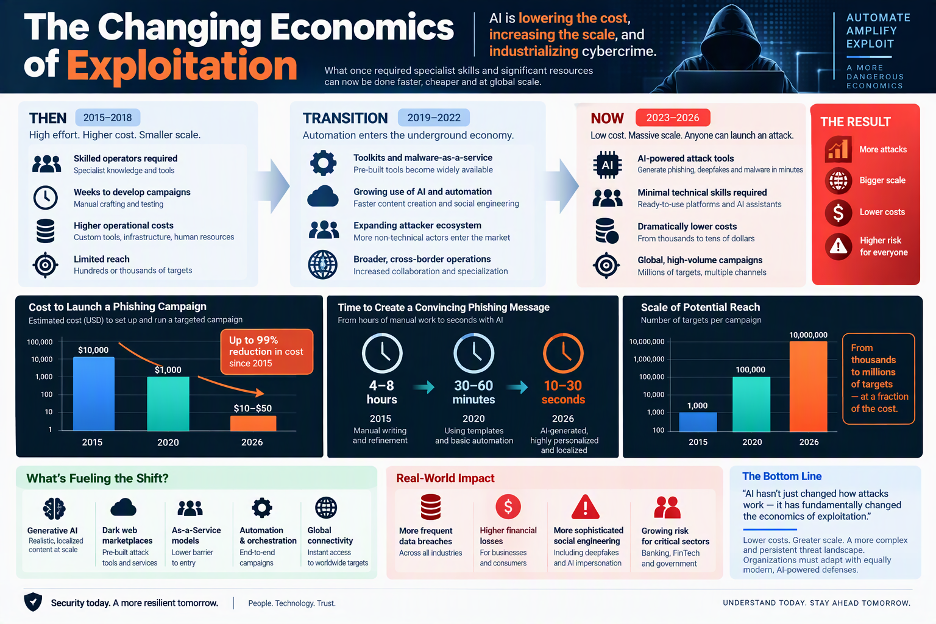
The changing economics of exploitation.
This capability benefits defenders as well. AI helped identify and remediate flaws that had survived years of scrutiny. The strategic issue is symmetry: the same tools that help defenders discover vulnerabilities can help attackers analyze patches, generate variants and adapt exploits after disclosure.
A Timeline Measured in Hours
| Date | Development | Strategic meaning |
| 19 August | Researchers discovered the first vulnerability using AI-assisted tools. Source: Wiz Research | AI contributed to finding a long-lived, complex flaw. |
| 20–21 August | Unauthenticated RCE was confirmed against representative Drupal and WordPress environments. Source: Wiz Research | Exploit development moved rapidly from discovery to proof. |
| 24 August | Vulnerabilities were reported to the PHP security team. Source: Wiz Research | Coordinated remediation began. |
| 17 October | AWS telemetry recorded an attempted exploit four days before public disclosure. Source: AWS Threat Intelligence | The public advisory date cannot be treated as the earliest possible compromise date. |
| 20 October | PHP announced an emergency security release scheduled for the following day. Source: PHP Security | Organizations had only a short preparation window. |
| 21 October | Fixed versions and public technical details were released; additional proofs of concept appeared within hours. Source: PHP Security, Source: AWS Threat Intelligence | Patch and exploit timelines converged. |
| 21 October | Cloudflare protections had been deployed roughly nine hours before public disclosure and subsequently observed mutated attack payloads. Source: Cloudflare Research | Compensating controls required continuous adaptation. |
| 23 October | PHP issued an additional informational advisory for a related session-upload-progress issue. Source: PHP Security | Remediation remained a moving target. |
| 24–26 October | Security researchers reported working shells in honeypots and exploitability against several stock application settings, while stressing that no universal exploit worked across all configurations. Source: Beazley Security Labs | High urgency had to be balanced with accurate statements about confirmed compromise. |
PHP2Shell discovery, disclosure and exploitation timeline.
The Patch-Window Assumption Has Broken
AWS’s October analysis draws a direct operational conclusion: for critical vulnerabilities in internet-facing systems, remediation targets should be measured in hours. It also recommends investigating from the earliest known exploit activity—not from the publication date—and using behavioral detections that do not depend on an existing CVE signature. Source: AWS Threat Intelligence
| Traditional assumption | AI-era operating assumption |
| Exploitation begins after disclosure | Exploitation may predate disclosure |
| Attackers wait for public proof of concept | More actors can analyze advisories and patch differences directly |
| A seven-day critical-patch target is aggressive | Internet-facing critical exposure may require action within hours |
| Application patches close the issue | The vulnerable runtime, library, image or embedded component may remain |
| WAF protection resolves the risk | WAF is a temporary layer; patching remains the complete remediation |
| “Attempts observed” means confirmed breach | Attempts, exploitability and successful compromise must be distinguished |
| Vendor assurance is sufficient | Enterprises need independent asset discovery and verification |
Comparison table: vulnerability management before and after AI-assisted exploit development.
Banking, FinTech and Enterprise Exposure
PHP2Shell was not a banking-specific vulnerability, but financial institutions should treat its pattern as highly relevant.
Potential exposure may sit in:
- Corporate and campaign websites.
- Customer onboarding or service portals.
- Merchant and partner platforms.
- Third-party administrative interfaces.
- Internal applications are exposed through remote-access pathways.
- Container images inherited from development pipelines.
- Digital agencies, hosting providers and managed-service platforms.
- Appliances or commercial software that embeds PHP in a management interface.
The business risk extends beyond website defacement. Successful exploitation could expose credentials, API keys, session tokens or certificates held in process memory, potentially enabling lateral movement into more sensitive environments. Source: Beazley Security Labs
This is why the incident belongs in board-level conversations about operational resilience. A seemingly peripheral web component can become an initial-access route into identity, cloud or data systems.
A Six-Step Response Model
1. Discover
Inventory PHP across servers, containers, appliances, development images and third-party products. Application inventories alone are insufficient because embedded runtimes may not be visible to the application owner.
2. Patch
Move supported branches to PHP 8.5.12, 8.4.27, 8.3.36 or 8.2.35, or obtain a verified vendor backport. PHP stated that updating was the only complete remediation for the two critical vulnerabilities. Source: PHP Security
3. Shield
Use WAF rules, upload restrictions and network isolation as temporary defense-in-depth measures. They reduce exposure but should not become a reason to delay runtime updates. Source: Cloudflare Research
4. Hunt
Review activity from at least 17 October. Look for malformed multipart requests, abnormal upload-progress behavior, repeated memory errors, worker crashes, unexpected PHP child processes, modified files and unusual outbound connections. Source: AWS Threat Intelligence, Source: Black Arrow Cyber Advisory
5. Rotate
If investigation suggests memory disclosure or compromise, rotate potentially exposed passwords, tokens, API keys and certificates. Patching removes the vulnerability; it does not undo previous access.
6. Assure the Supply Chain
Require hosting providers and software vendors to confirm exposure, remediation status, evidence of exploitation and expected completion dates. Where the answer is “under investigation,” establish a follow-up deadline and temporary containment plan.
Opportunities Created by the Same Technology
AI-assisted vulnerability research should not be viewed only as an offensive development. It can improve secure engineering by:
- Examining older, memory-unsafe code that has resisted conventional analysis.
- Generating and testing edge cases before release.
- Validating patches against related vulnerability variants.
- Prioritizing exposures using runtime and business context.
- Translating technical advisories into environment-specific remediation actions.
- Continuously testing internet-facing applications after changes.
The opportunity is to institutionalize these capabilities inside secure development and exposure-management programs—before adversaries apply them on a scale.
Risks and Challenges
The most difficult problem is not patching availability; it is asset certainty.
Organizations often cannot answer which business services rely on a particular runtime, especially when the component is embedded in a supplier’s platform. Unsupported versions, custom builds and vendor backports further complicate version-based scanning.
Leaders should also resist two forms of false confidence:
- A WAF match is not proof that an exploit succeeded.
- A successful patch does not prove the environment was uncompromised beforehand.
Good crisis communication must distinguish attempted exploitation, demonstrate exploitability and confirm compromise.
Future Outlook
PHP2Shell is unlikely to be the last case in which AI turns an old, difficult vulnerability into a practical exploit. The next phase will feature automated analysis of patch differences, environment-specific exploit adaptation and faster mutation of payloads against defensive controls.
Vulnerability-management programs will consequently become more event-driven. Critical internet-facing issues will trigger immediate asset discovery, compensating controls, threat hunting and executive escalation in parallel—not as sequential tasks spread across several weeks.
The patch window is not merely shrinking. For certain classes of exposure, it is disappearing.
Executive Takeaways
- Measure critical internet-facing remediation in hours, not routine monthly cycles.
- Investigate before the disclosure date when threat telemetry indicates earlier activity.
- Inventory embedded runtimes and supplier components, not just named applications.
- Use WAF and isolation as temporary controls; patching remains essential.
- Adopt AI for defensive research and patch validation before exploit adaptation becomes broadly automated.