

An AI assistant that recommends a purchase is useful. An AI agent that can select, authorize and pay changes the structure of commerce.
September 2026 marked an important transition. Danske Bank and Mastercard completed Denmark’s first purchase and payment carried out by an AI agent on a consumer’s behalf. The agent booked a coffee-tasting experience using a Danske Bank-issued Mastercard; Mastercard Agent Pay handled the payment and PayOS executed the transaction flow. Explicit consent and Mastercard Payment Passkeys were used to keep the transaction authenticated and under consumer control
That transaction was modest. Its implications were not.
The payment industry is building an identity layer for machines
Agentic commerce changes the central authentication question. Financial institutions must establish not only who owns the account, but also which agent is acting, for whom, under what authority and within what limits.
On September 9, Ant International, Mastercard and Visa began collaborating on an interoperable Know Your Agent framework. The proposed model centers on operator traceability, shared certification requirements and continuous monitoring, while allowing each network to retain its own verification and decisioning processes.ant-intl+1
Later in the month, Commonwealth Bank, ASB Bank, Bank of America, Capital One, ING and NatWest published joint principles covering transparency, safety, privacy, customer choice and interoperability. On September 30, Mastercard added identity, intent, behavioral and fraud signals to its Agent Pay Trust Framework, including a probability score intended to indicate whether a transaction was AI-initiated.
The following diagram illustrates the control sequence required to turn delegated intent into an auditable payment.
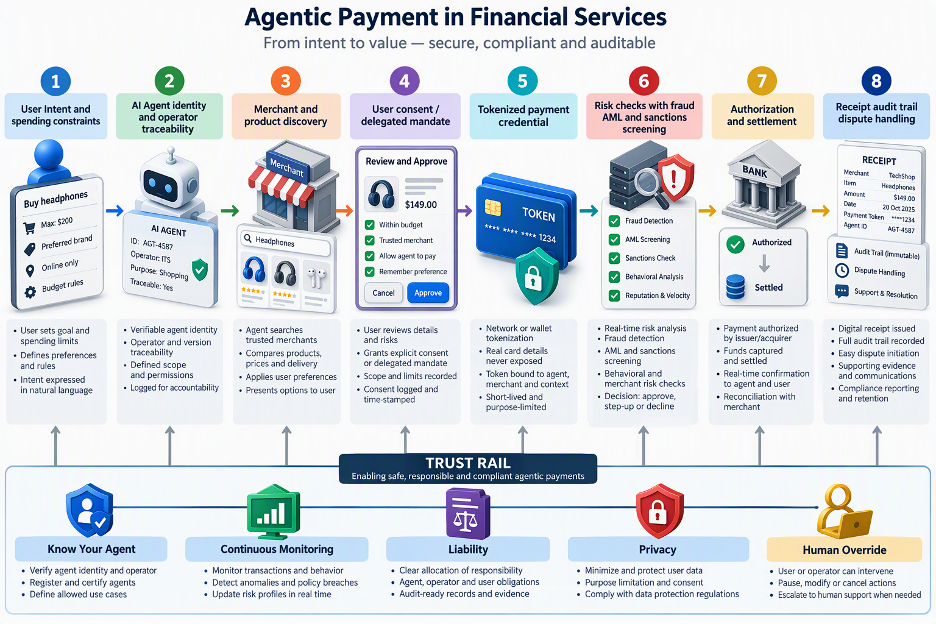
A governed agentic-payment flow turns user intent into an auditable transaction through agent identity, delegated authority, tokenized credentials, risk controls and settlement.
Why the opportunity extends beyond consumer shopping
The Federal Reserve’s September 29 assessment distinguished between agent-assisted commerce, where the buyer remains in control of checkout, and agent-delegated commerce, where an agent acts within predefined constraints. It also identified business-to-business procurement as a potentially strong use case because approved suppliers, spending limits and recurring purchases naturally lend themselves to rules-based automation.
Potential applications include:
- automated replenishment within agreed vendor and budget limits;
- travel or purchasing workflows requiring multiple bookings;
- payment routing based on cost, speed and reliability;
- treasury optimization and reconciliation; and
- low-value machine-to-machine payments for data or API access.
However, deterministic money movement and probabilistic AI do not fit together automatically. Institutions must address consent evidence, transaction limits, liability, fraud-model recalibration, data privacy, merchant-agent recognition, dispute handling and a reliable human override.
GCC/MEA relevance: readiness before autonomy
September did not provide sufficient evidence to claim widespread GCC deployment of autonomous consumer payments. The regional signal was instead infrastructure and investment readiness.
Mubadala’s September investment in Paymob is particularly relevant: the financing supports MENA expansion, SME payment products and an explicit roadmap for agentic commerce. Paymob reported that GCC revenue had grown sevenfold over the preceding 18 months and that it had onboarded approximately 20,000 merchants across three GCC markets after receiving its UAE retail-payment license.
Saudi Arabia also continued expanding its payment-acceptance infrastructure. SAMA announced that Tap to Pay on iPhone would allow compatible devices to accept mada cards, other contactless cards and digital wallets through NFC. Although this is not agentic commerce, software-based acceptance and broad digital-payment coverage are important foundations for future AI-mediated commerce.
What financial institutions should do now
The immediate priority is not to grant agents unlimited payment authority. It is to create a controlled agent-payment lane:
- distinguish AI-originated activity from human-originated activity;
- bind every agent to an identifiable operator;
- capture machine-readable consent, purpose, value and time limits;
- tokenize credentials rather than exposing account data;
- monitor agent, user, merchant and transaction behavior together; and
- preserve revocation, escalation and dispute evidence.
The competitive advantage will not come from the most autonomous agent. It will come from the most trusted, interoperable and governable one.
Infographic recommendations
- “The Agentic Payment Trust Stack”: intent → agent identity → mandate → credential → risk decision → settlement → audit.
- “Human Checkout vs. Agent Checkout”: compare authentication, consent, fraud signals, liability evidence and customer-service requirements.
- Regional readiness map: payment acceptance, real-time rails, open-finance APIs, digital identity and agent-governance readiness—qualitative unless comparable statistics are available.