

The next phase of FinTech growth is not about launching another isolated feature. It is about assembling the licenses, infrastructure, capital and operating controls required to become a durable financial platform.
September offered several versions of the same story. The OCC granted preliminary conditional approval for Revolut Bank US, subject to pre-opening conditions, Federal Reserve membership and FDIC deposit insurance. The proposed bank would provide deposits, credit, payments, digital-asset services and financial-management tools through a digital application.occ+1
In Europe, Mollie completed its acquisition of GoCardless, creating a combined platform serving more than 350,000 businesses across over 30 markets. The proposition brings cards, local payment methods, Pay by Bank, accounts and business financing closer to a single financial home.
From point solution to platform
The strategic pattern has five stages:
- solve one visible pain point;
- acquire regulated permissions and trusted distribution;
- add adjacent services using shared data and infrastructure;
- build compliance, risk and resilience at scale; and
- consolidate capabilities or enter regulated banking.
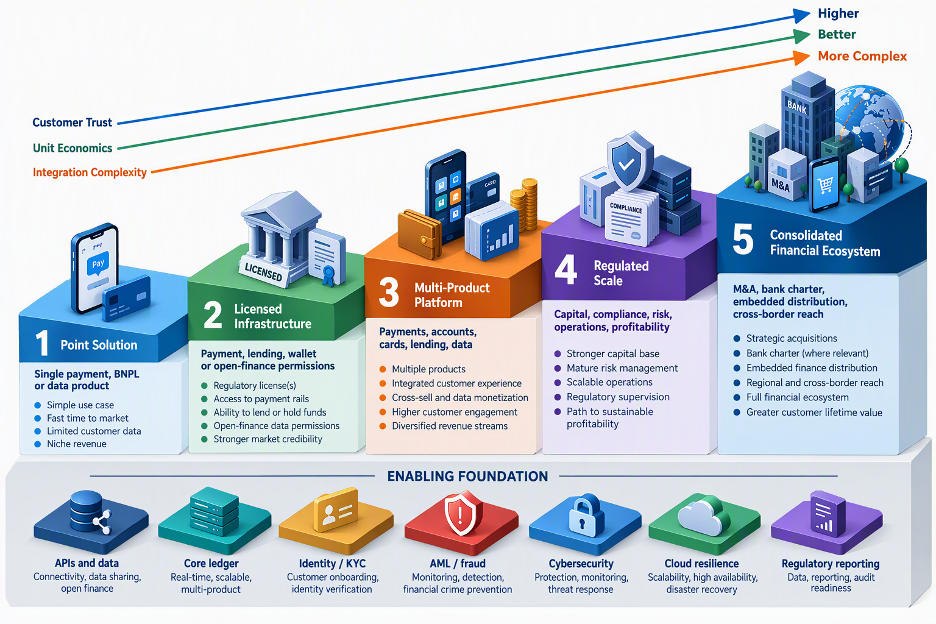
FinTech scale is increasingly built by layering licenses, infrastructure, controls and adjacent products—not by adding features alone.
This model can produce deeper relationships and improve economics, but it also increases complexity. A broader platform must manage credit, liquidity, conduct, AML, fraud, cybersecurity, third-party risk, customer complaints and regulatory reporting, not just user-experience design.
GCC/MEA is producing its own platform builders
Tabby’s September $233 million equity round valued the company at $6.5 billion and supports its expansion beyond buy now, pay later into broader credit and money-management services. Tabby cited Saudi consumer and SME finance licenses, its acquisition of the Tweeq digital wallet and a UAE Stored Value Facilities license as foundations for accounts, cards, transfers and Tabby Cash.tabby+1
Tarabut raised $50 million from Saudi financial institutions and business groups to deepen its regulated embedded-finance platform. Its model combines verification, real-time cash-flow information, credit decisioning and financing within partner institutions’ customer journeys—especially for SMEs.tarabut+1
Paymob’s $35 million pre-Series C similarly supports MENA payments expansion and new SME products. Its platform consolidates more than 60 payment methods through one technology layer, addressing a regional environment in which merchants may otherwise manage seven or eight separate payment-method relationships.df4b1480da.png
These developments align with MAGNiTT’s H1 2026 findings: MENA FinTech funding reached $617 million across 57 transactions; deal activity fell by 50% year over year, while larger transactions became more influential. The UAE and Saudi Arabia together captured 85% of regional FinTech funding, and regional investors accounted for 81% of deployed capital.
What the market is rewarding
September’s evidence favors platforms that can demonstrate:
- a regulated right to operate;
- genuine transaction or API usage;
- a path from one product into logical adjacencies;
- institutional partnerships rather than distribution alone;
- disciplined capital and operating economics; and
- infrastructure that can cross borders without ignoring local regulation.
The risk is overextension. Product breadth does not automatically create platform strength. Successful expansion requires a reusable customer identity, coherent data architecture, unified financial-crime controls, reliable ledgers and clear ownership across markets.
For banks, the response need not be to copy every FinTech product. Banks can partner, embed, invest or acquire where FinTech infrastructure improves distribution and execution. For FinTechs, the path to scale increasingly runs through the regulated financial system—not around it.