
Stablecoins, CBDCs, tokenized deposits and modern payment rails are becoming core financial infrastructure. Here is what banks in MEA, Africa and CIS should prepare for now.
Digital money is entering a new phase. It is no longer only a debate about crypto adoption or central bank experiments. It is becoming an infrastructure question for banks, payment providers, regulators and enterprises: which forms of digital value will move across the financial system, on which rails, under which controls, and with what level of trust? The IMF’s 2026 analysis frames tokenization as the issuing and transfer of assets on blockchain-based infrastructure, with implications for market structure, risk management and financial stability. In parallel, the BIS notes that tokenization could carry the strengths of deposits into a programmable financial system while preserving trust in money.
For MEA, Africa and CIS, the opportunity is not theoretical. The UAE’s Payment Token Services Regulation is already in force and defines regulated payment-token services across issuance, conversion, custody and transfer. Nigeria’s Central Bank sandbox has opened a dedicated track for virtual assets and stablecoins, including wallets, custody, fiat on/off-ramp arrangements and payment use cases. Kazakhstan is using the digital tenge in public procurement from August 2026 after issuing 340 billion digital tenge and completing multiple pilot projects. Russia’s large-scale digital ruble rollout starts on 1 September 2026 for major banks and selected retailers, expanding in stages through 2028.
Why this matters now
The stablecoin market has reached enough scale to attract serious policy and banking attention. DIFC/MESA reported global stablecoin market capitalization at around USD 311 billion, up from roughly USD 28 billion in 2020, with Citi projections cited at USD 1.9 trillion in a base case and USD 4.0 trillion in a bull case by 2030. The IMF separately noted stablecoin market capitalization at around USD 300 billion, with nearly 99% denominated in U.S. dollars, and highlighted both the payment-efficiency potential and emerging-market policy risks.
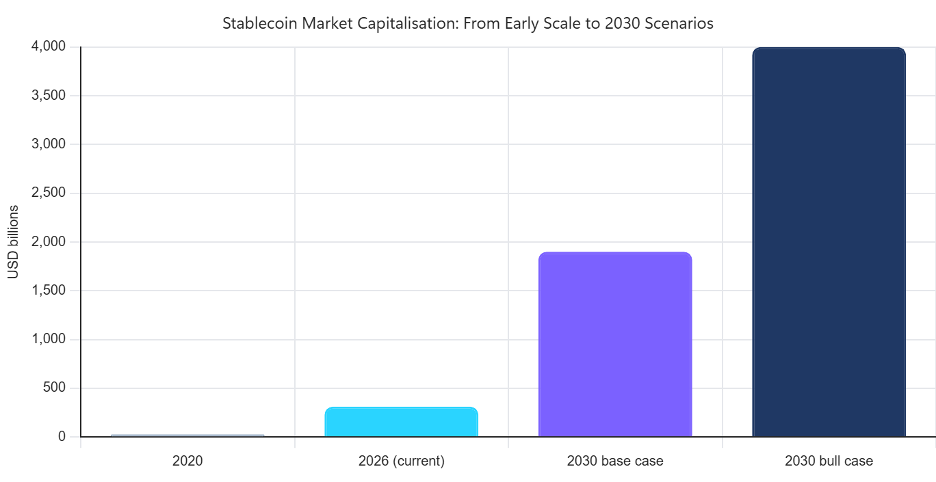
Stablecoin market-cap growth and 2030 scenarios. Use as an executive visual to show why digital-money infrastructure is moving from edge topic to board-level agenda.
The digital money stack banks must understand
Digital money should be understood as a stack, not as a single product. At the infrastructure layer are RTGS systems, instant payment rails, PAPSS, public or permissioned ledgers, open banking APIs and settlement systems. At the asset layer are stablecoins, tokenized deposits, CBDCs, tokenized central bank reserves, mobile money and tokenized securities. At the services layer are wallets, banking apps, merchant acquiring, remittances, treasury tools, smart contracts and compliance monitoring. The IMF’s tokenization framework similarly separates infrastructure, asset and services layers, noting that stablecoins, tokenized deposits, CBDCs and tokenized money-market funds can sit at the asset layer.
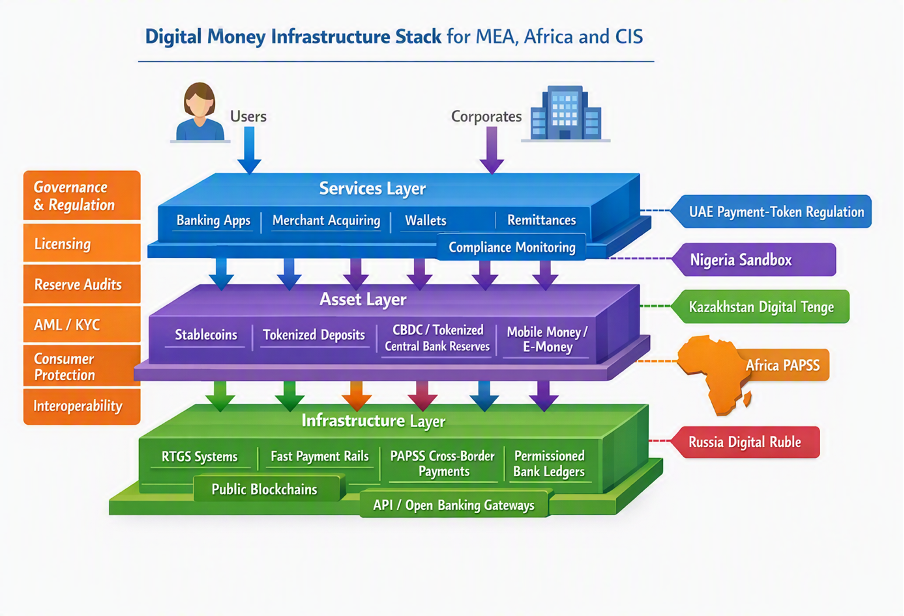
Digital money is not one product; it is a layered infrastructure stack where payment rails, tokenized assets, customer-facing services, and governance controls must operate together.
Africa’s payment rails are a critical part of the story
In Africa, digital money should not be discussed without payment interoperability. PAPSS describes itself as a cross-border financial market infrastructure enabling payment transactions across Africa and supporting instant or near-instant transfers in local currencies. This matters because it gives banks and payment providers a route to reduce cross-border payment complexity without defaulting to external currency conversion. PAPSS also states that participating in commercial banks, payment providers and intermediaries can reduce foreign exchange complexity and provide instant secure cross-border payments to customers across Africa.
This does not eliminate the relevance of stable coins. It reframes them. The winning architecture for Africa is unlikely to be “stablecoins versus local rails.” It is more likely to be regulated stablecoins plus local-currency settlement rails plus strong compliance and interoperability. In that environment, banks can help clients choose the right instrument: local rails for domestic and regional settlement, stablecoins for selected treasury or cross-border use cases, tokenized deposits for bank-money programmability, and CBDCs or tokenized reserves where central banks make them available.
The bank opportunity: orchestration, not speculation
The clearest opportunity for banks is not to “become crypto companies.” It is to become trusted orchestrators of digital value. That means managing custody, compliance, settlement, customer identity, risk controls, transaction monitoring, reconciliation and integration with core banking systems. The UAE regulation makes this direction clear by placing licensing, customer protection, reserve safeguards, reporting and AML/CFT expectations around payment-token services. The IMF also emphasizes that stablecoins and tokenized deposits raise distribution, governance, legal claim and loss-absorption questions that regulators and market participants still need to resolve.
Closing message
Digital money is becoming infrastructure. The institutions that win will not be those that chase every new token. They will be those that can connect regulated digital assets, payment rails, compliance controls and customer services into a trusted operating model. For MEA, Africa and CIS, this is a timely opportunity: build the architecture now, while the standards are still being shaped.