


AI adoption in banking is accelerating, but measurable ROI depends on governance, architecture and mature execution. Here is what African and MEA banks should prioritize.
AI in banking has moved beyond experimentation. The more important question for 2026 is not whether banks are using AI, but whether they can measure its return, scale it responsibly and connect it to business performance. Backbase and African Banker’s 2026 research, based on 277 senior banking executives across 37 African countries, found that 67.1% of banks measure AI ROI, while 85.1% of those that measure ROI report results meeting or exceeding original projections. That is a powerful signal: AI value is visible where banks have the discipline to measure it.
Yet the same research shows the gap. Banks that do not formally measure ROI still often plan to increase AI spending, creating a mismatch between board expectations and management visibility. This is why AI maturity must now be treated as a performance-management discipline, not only a technology roadmap.
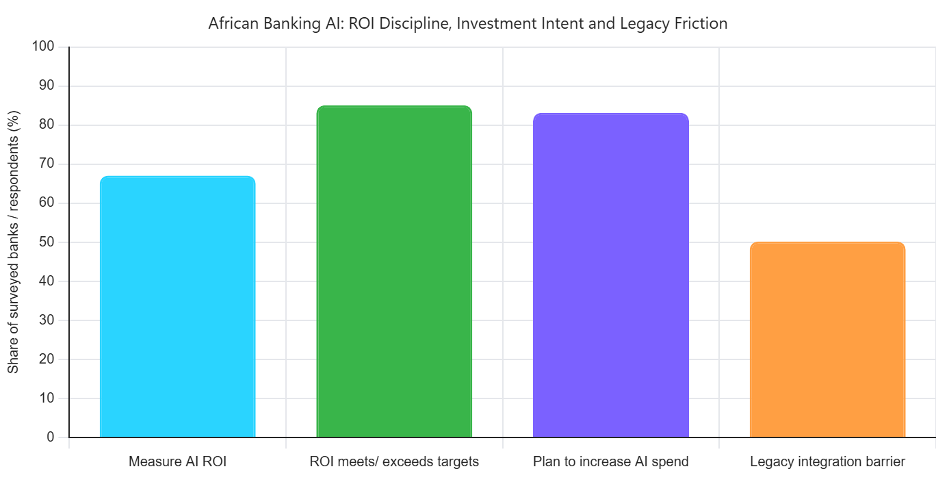
African banking AI ROI discipline, investment intent and legacy-system friction. Use this visual to frame the article around measurable execution rather than hype.
The MEA maturity picture: leaders are scaling use cases and outcomes
The Evident AI Index for Banks — MEA edition ranked 25 major Middle Eastern and African banks across transparency, leadership, innovation and talent. Its first MEA report identified Emirates NBD, Standard Bank Group, First Abu Dhabi Bank and Nedbank Group as regional frontrunners, and noted that the 25 banks documented more than 50 AI use cases over two years. This matters because mature banks are no longer proving that AI can work; they are building repeatable operating models that turn use cases into outcomes.
The same report highlights two constraints that should guide strategy. First, AI talent remains a core scaling constraint, with regional AI development talent relative to headcount at about half the level of Evident’ s global-bank benchmark. Second, the region is moving toward a more demanding AI compliance horizon, shifting from soft-law guidance toward more binding frameworks. For banks, that means AI programs must be designed for auditability, explainability and regulatory readiness from the beginning.
Where AI is already producing value
The strongest AI banking use cases are not always the most futuristic. Backbase’s African banking research identifies fraud detection and transaction monitoring as highly impactful, followed by credit scoring, particularly alternative credit assessment for thin-file customers. The same source cites World Bank Findex data showing Sub-Saharan Africa account ownership at 58%, leaving 42% of adults unbanked, which makes scalable AI-assisted credit assessment especially relevant to inclusion strategies.
Customer engagement is another area of measurable impact. Emirates NBD’s 2026 partnership with Dubai Future District Fund aims to source, pilot and adopt FinTech and AI solutions aligned with customer experience, risk management and operational efficiency. The bank identified focus areas including AI-driven banking capabilities, embedded finance, digital assets, SME solutions, WealthTech, compliance technologies and next-generation banking infrastructure.
The hidden blocker: architecture
AI failure in banking is often framed as a model problem. The evidence suggests it is frequently an architecture problem. Backbase reports that legacy system integration was the top internal obstacle, cited by 50.2% of respondents, and that 57.9% of non-measurers named legacy integration as their greatest challenge. If data is fragmented across core banking, CRM, channels, compliance systems and reporting layers, banks cannot reliably attribute outcomes to AI interventions.
This is where the AI maturity conversation becomes operational. Banks need integrated data architecture, governed feature stores, API-ready systems, model monitoring, human-in-the-loop controls and dashboards that connect use cases to KPIs. Without these foundations, AI becomes a collection of disconnected pilots. With them, it becomes a measurable transformation capability.
What banking leaders should do now
- Measure ROI before scaling spend. Define ROI metrics by use case: fraud-loss reduction, onboarding time, service deflection, credit-approval accuracy, cost-to-serve, cross-sell, compliance cycle time and customer satisfaction.
- Separate experimentation from production. Keep innovation sandboxes, but establish stricter production gates for models affecting customers, credit, risk or compliance.
- Modernize data and integration layers. Prioritize data quality, API orchestration and real-time event streams before expanding AI into high-stakes workflows.
- Treat governance as a maturity signal. Evident’s MEA findings show that leading banks document more use cases and outcomes, while the region’s compliance environment is becoming more demanding. Governance should accelerate responsible scaling, not slow it down.
- Build regional relevance. Africa and MEA banks should prioritize inclusion, fraud, SME finance, multilingual service, Islamic/ethical finance use cases, compliance automation and localized customer journeys.
Closing message
AI banking leadership in Africa and MEA will not be defined by who launches the most pilots. It will be defined by who measures value, governs risk, modernizes architecture and scales use cases that matter. The next stage of AI transformation is therefore not only about intelligence. It is about measured intelligence: AI that improves performance, strengthens trust and gives banking leaders the evidence they need to invest with confidence.