

August 2026 shows why ransomware defense must start at the edge. Learn how Gunra, SharePoint exploitation, KEV vulnerabilities, and Patch Tuesday pressure are reshaping cyber resilience.
Ransomware is no longer only an endpoint problem. In 2026, the attack often begins at the edge — VPN gateways, firewalls, exposed servers, and collaboration platforms — then moves through identity systems, cloud storage, backup environments, and business-critical data before encryption becomes visible.
CISA’s August 10, 2026 #StopRansomware advisory describes Gunra as a ransomware-as-a-service variant used by affiliates to target government, critical infrastructure, and other organizations, with a double-extortion model that encrypts data and threatens publication of exfiltrated data if ransom is not paid. The advisory says Gunra first appeared in 2025 and expanded to RaaS operations in 2026. [cisa.gov]
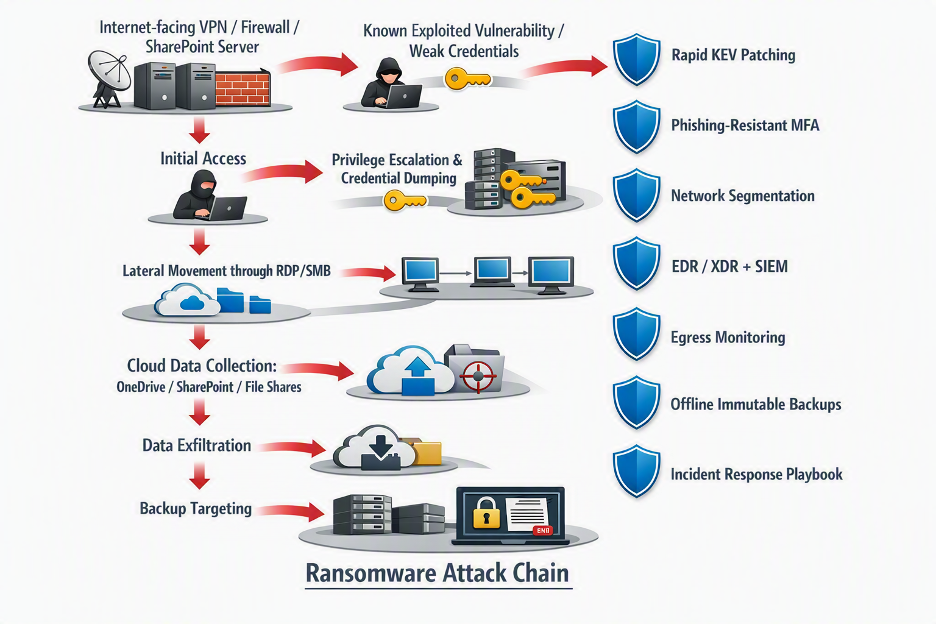
Modern ransomware often starts at the edge, then moves through identity, cloud data, and recovery systems before encryption becomes visible.
Gunra shows why edge security is now ransomware defense
CISA and partner agencies reported that Gunra actors obtain initial access primarily through exploitation of known vulnerabilities in internet-facing devices, including firewall and VPN appliances; the advisory specifically identifies CVE-2024-55591 and CVE-2025-24472 affecting FortiOS and FortiProxy versions. The same advisory describes Gunra’s use of credential dumping, lateral movement, log clearing, late-night activity, data collection, exfiltration, and encryption as part of a broader ransomware operation. [cisa.gov]
For business leaders, the message is clear: edge devices are not passive infrastructure. They are frontline identity and access systems. If they are unpatched or poorly monitored, they can become the doorway into the enterprise.
Patch Tuesday is no longer routine maintenance
Microsoft’s August 2026 Patch Tuesday delivered security updates for 400 flaws, including one actively exploited zero-day and two publicly disclosed zero-days, according to Bleeping Computer’s report. The same report listed 176 elevation-of-privilege vulnerabilities, 110 remote-code-execution vulnerabilities, 86 information-disclosure vulnerabilities, 21 spoofing vulnerabilities, 12 denial-of-service vulnerabilities, and 11 security-feature-bypass vulnerabilities.
Microsoft August 2026 Patch Tuesday vulnerability categories. The highest-volume categories were elevation of privilege, remote code execution, and information disclosure, based on Bleeping Computer’s published breakdown.
This volume matters because patching is no longer simply a monthly IT checklist. It is a risk-prioritization discipline. Security teams should prioritize actively exploited vulnerabilities, internet-facing systems, privilege escalation flaws, remote-code-execution paths, identity infrastructure, and collaboration platforms before lower-exposure systems.
SharePoint exploitation raises the stakes
CISA warned in July 2026 that multiple SharePoint Server vulnerabilities were under active exploitation, affecting supported on-premises SharePoint Server versions and involving remote-code-execution and post-exploitation activities such as stealing IIS machine keys, persistence, and malware deployment. CISA urged organizations to apply Microsoft patches, verify installation, shorten patching cycles, enable AMSI integration, monitor telemetry, avoid direct internet exposure where possible, and restrict external access to SharePoint Central Administration.
By August 11, Bleeping Computer reported that CISA had confirmed ransomware gangs were abusing CVE-2026-45659, a high-severity SharePoint remote-code-execution vulnerability flagged as actively exploited since early July. The same report noted that CISA had added vulnerability to its Known Exploited Vulnerabilities Catalog on July 1 and that ransomware abuse had now been flagged in the KEV Catalog.
What organizations should do now
Based on the August 2026 threat picture, organizations should take five immediate actions:
- Patch KEV-listed and actively exploited vulnerabilities first. Prioritize internet-facing VPNs, firewalls, SharePoint servers, RDP-exposed infrastructure, and identity-adjacent systems.
- Validate edge-device configuration. Confirm firmware versions, remove default or dormant accounts, enforce account lockout controls, and review privileged access logs.
- Harden collaboration platforms. For SharePoint Server, apply latest patches, verify AMSI integration, restrict Central Administration access, and review suspicious worker-process activity, webshell indicators, and machine-key access.
- Protect recovery before encryption. CISA’s Gunra guidance emphasizes offline, immutable backups stored in a physically separate, segmented location and tested for recovery.
- Monitor exfiltration, not only encryption. Gunra’s model includes data exfiltration before encryption, and CISA reported use of a malicious executable to exfiltrate victim data from OneDrive and SharePoint.
Closing thought
The August 2026 ransomware lesson is straightforward: ransomware defense must start before ransomware. Patch faster, harden the edge, monitor identity and collaboration platforms, protect backups, and assume that data exfiltration may occur before encryption. Organizations that treat ransomware as an end-to-end resilience problem — not a single malware event — will be better prepared to absorb, contain, and recover.